
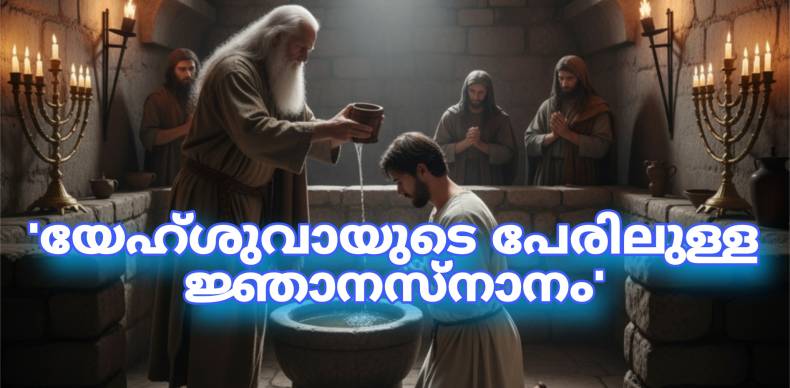
In whose name did you receive baptism? Manova places such a question before you! You should not underestimate the importance of this question. For this is the question that the apostle Shauwul once asked the believers who were present when he visited a church community. In the Bible it reads thus: “While Appollo was at Korinth, Shauwul travelled through the interior regions and reached Ephesos. There he found some disciples. He asked them: Did you receive the Holy Spirit when you became believers? They said: No, we have not even heard that there is a Holy Spirit. He asked: Then what baptism did you receive? They said: The baptism of Yohannan. Then Shauwul said: Yohannan gave the baptism of repentance, exhorting the people to believe in the one who was to come after him, that is, in Yehshuwah. Hearing this, they received baptism in the name of the Heavenly Lord Yehshuwah. When Shauwul laid his hands on them, the Holy Spirit came upon them. They spoke in other tongues and prophesied”(Acts of the Apostles: 19; 1-6).
What we have read here is a message that clarifies the importance of baptism in the name of Yehshuwah. Throughout the coming study paths, this message must remain in our memory. For this is the only way before man to enter the Kingdom of God. Therefore, we must systematically come to know the importance of baptism, the baptisms that exist today, and which among them is the true baptism to which entry into the Kingdom of God has been promised. Note the verse that clarifies the importance of this knowledge: “What does it profit a man if he gains the whole world but loses his own soul? What will a man give in exchange for his own soul?”(Matthai: 16; 26). The importance of the study we conduct here is contained in this question of Yehshuwah. Therefore, we begin here the study about baptism.
The Necessity of Baptism!
The one who first proclaimed the necessity of baptism was Yehshuwah. Yehshuwah unequivocally declared that unless one is born again of water and of the Spirit, one cannot even see the Kingdom of God. This is recorded in the Bible thus: “Yehshuwah said: Truly, truly I say to you, unless one is born again, one cannot see the Kingdom of God”(Yohannan: 3; 3). Baptism is the rebirth of water and of the Spirit. Yehshuwah declared not only that those who do not receive baptism will not see the Kingdom of God, but also that baptism is essential to enter the Kingdom of God. Note a portion of the conversation Yehshuwah had with Nikkodemon: “Nikkodemon asked: How can this be possible for an aged man? Can he enter again into his mother’s womb and be born? Yehshuwah answered: Truly, truly I say to you, unless one is born of water and of the Spirit, it is not possible for anyone to enter the Kingdom of God. That which is born of flesh is flesh; that which is born of the Spirit is spirit” (Yohannan: 3; 4-6).
There are many who have mistakenly understood that by the Kingdom of God Yehshuwah here meant heaven. They are those who do not understand the difference between Paradise (Garden of God/Eden), the Kingdom of God, and heaven. The garden of Eden, which is called Paradise, is the garden of God where Adam and Hawwah dwelt and which God carried up on high. Through committing sin, Adam and Hawwah were expelled from this garden. With the death of Yehshuwah, this garden was opened again. The souls of all the righteous who had died until then entered, together with Yehshuwah, the garden of Eden which is called Paradise. That is, the souls of the righteous who received baptism in the name of Yehshuwah and became part of the apostolic church now dwell in Paradise.
However, there are among the Constantine Christians those who spread the misconception that heaven itself is Paradise. These people carry out this propaganda even when there is clear proof in the Bible that heaven and Paradise are not one. This becomes clear when we examine together two verses spoken by Yehshuwah. The first verse is a revelation concerning Paradise. It is recorded thus: “Yehshuwah said to him: Truly I say to you, today you will be with me in Paradise”(Luka: 23; 43). This is the word Yehshuwah spoke to one of the criminals crucified with him. If Yehshuwah has said that you will be with me in Paradise today, then it has happened exactly so. For we know that he does not speak empty words. That is, we can understand that Yehshuwah visited Paradise even before he was raised. Moreover, he descended into the netherworld and preached the gospel to the imprisoned souls.
Note the writing that clarifies this: “Going with the spirit, he preached the gospel to the imprisoned souls. They were those who had been disobedient to God, who waited patiently in the days of Noah when the ark was being built”(1 Kepha: 3; 19, 20). Note also a writing in the fourth chapter: “For this reason the gospel was preached even to the dead, that though judged in the flesh like men, they might live in the spirit like God”(1 Kepha: 4; 6). What we have seen here is proof that Yehshuwah preached the gospel to the imprisoned souls. But it is recorded in the Bible that he not only preached the gospel but also took those who believed together with him into Paradise. Look at this revelation: “Therefore it is said: When he ascended on high, he led a great number of captives with him”(Ephesos: 4; 8). We can understand through the following description that these captives had been in the netherworld. The description is thus: “What does it mean that he ascended? Does it not also mean that he descended into the lower parts of the earth?”(Ephesos: 4; 9).
All these writings tell us many things. Only if it becomes essential at some stage as this study proceeds will those matters be discussed here. For we examined these writings to clarify that Paradise and heaven are different places. All these writings refer to Paradise. The holy writings testify that after Yehshuwah rose again, he remained on this earth itself for forty days.
Note the writing that testifies that he ascended into heaven on the fortieth day: “After his suffering, Yehshuwah appeared among them for forty days and taught about the Kingdom of God. Thus, giving them sufficient proofs, he appeared as one living”(Acts of the Apostles: 1; 3). Besides this, one can read in the Bible that Yehshuwah told several people at various times that he had not yet ascended into heaven. Note this verse: “Yehshuwah said: Do not hold me back. For I have not yet ascended to the Father. Go to my brothers and tell them that I am ascending to my Father and your Father, to my God and your God”(Yohannan: 20; 17).
When we examine these writings together, we can understand that the risen Yehshuwah did not ascend into heaven until forty days were completed. However, his own words confirm that Yehshuwah, the Son of Man, visited Paradise on the very day he died. These verses were shared here to clarify that heaven and Paradise are different places. Now what we must understand is the difference between heaven and the Kingdom of God. Like the misconception that heaven and Paradise are one, many hold a similar erroneous notion regarding the Kingdom of God. In reality, the Kingdom of God and heaven are different places. However, it can be understood that the Kingdom of God has also been described as the Kingdom of Heaven.
Since Luka and Marko describe the same event as the Kingdom of God, and Matthai as the Kingdom of Heaven, where three evangelists narrate the same event, it is clear that the two are one. If we examine the description given by these three evangelists of a similar event, we will gain more clarity on this subject. Note a verse from the Gospel written by Matthai: “Yehshuwah said to the disciples: Truly I say to you, it is difficult for a rich man to enter the Kingdom of Heaven” (Matthai: 19; 23). Here it is recorded as the Kingdom of Heaven. Look at how Marko recorded this same event: “Yehshuwah looked around and said to the disciples: How hard it is for a rich man to enter the Kingdom of God!”(Marko: 10; 23). Marko has here recorded it as the Kingdom of God. What Luka recorded is also the same. Note that too: “Yehshuwah looked at him and said: How difficult it is for those who have wealth to enter the Kingdom of God!”(Luka: 18; 24).
It became clear by examining these verses together that the Kingdom of Heaven and the Kingdom of God are one and the same. There is another matter to understand here. For among the evangelists who recorded this event, only Matthai was in the group of Yehshuwah’s twelve apostles. Matthai was a disciple who travelled with Yehshuwah throughout the period of his mission. Therefore, it is likely that Matthai alone was the evangelist who heard this verse directly from Yehshuwah. If so, we can understand that what Yehshuwah said as part of a parable was indeed “Kingdom of Heaven.” This is where we must consider the reason why Marko and Luka recorded it as the Kingdom of God.
There is a reason why the evangelists Marko and Luka recorded it as the Kingdom of God in their gospel writings. Before clarifying that, let me reveal the reason why Yehshuwah and Matthai said Kingdom of Heaven. The people of Yisrael, especially the Yehudim (Jews), tried not to speak the name of God or the word God itself in connection with anything else. Instead of “God,” they mostly said “heaven.” We know that Yehshuwah preached among the people of Yisrael, who consisted of Yehudim and Shemaritans. Likewise, Matthai wrote his gospel for the Christians from Yehudim who were scattered in Palestine and the surrounding regions. That is why Yehshuwah and Matthai chose the commonly accepted word “Kingdom of Heaven.”
One reason the Yisraelites hesitated to use even when necessary the word God and the name Yahweh was the fear that uttering it would be a misuse. Another reason is that, because there was even a prohibition against uttering the name of their God during the exile, the habit of calling upon that name gradually grew away from them. We know that the people of Yisrael were in exile for a very long time. The fear that gripped them during those days of living subject to the gentiles hunted them even in later times. It was because two kinds of fear thus gripped them that uttering “God” and “Yahweh” became uncommon among the Yehudim. This clarifies the reason why Matthai, who composed his writing for the Yehudim, recorded “Kingdom of Heaven” instead of “Kingdom of God” in his gospel.
However, Marko and Luka did not compose their writings intending only the Yisraelites. Therefore, they chose the word “Kingdom of God,” which everyone could understand and which was commonly accepted by all. In Hebrew, the Kingdom of God is called “Malkuth Elohim,” and the Kingdom of Heaven is called “Malkuth Shemayim.” The only difference in these words, which contain the same idea, is that in one the word Elohim (God) is added. We have understood here that the Kingdom of Heaven is another designation for the Kingdom of God. We have also seen that Paradeesa is not heaven. Likewise, there is another matter we must understand. That is, before studying about baptism in the name of Yehshuwah, we must understand that Paradise, the Kingdom of God, and heaven referred to in the Bible are three different places.
Paradise is the place where the souls of the righteous dwell after the death of Yehshuwah! However, heaven is the dwelling place given to the righteous after the final judgment. If one of the criminals crucified with Yehshuwah was able to pass into Paradise that very day, Yehshuwah has declared that heaven will be given as inheritance to the apostles only after his return. Note his words: “Let not your heart be troubled. Believe in God; believe also in me. In my Father’s house there are many dwelling places. If it were not so, would I have told you that I go to prepare a place for you? When I go and prepare a place for you, I will come again and take you with me, that where I am you also may be. You know the way to where I am going”(Yohannan: 14; 1-4).
Here Yehshuwah referred to heaven. The souls of the righteous who die before Yehshuwah’s return dwell in Paradeesa until his return. Only after that are they raised with their bodies. That is the first resurrection spoken of in the Book of Revelation. That is, Yehshuwah will come next together with his saints. Look at the prophecy of Shekhariyah: “Yahweh my God will come, with all his saints”(Shekhariyah: 14; 5). Shekhariyah prophesied thus before the full name Yehshuwah was revealed. Note another prophecy: “I saw a Lamb standing on Mount Siyon; and with him one hundred forty-four thousand. On their foreheads were written his name and his Father’s name”(Revelation: 14; 1). The Lamb spoken of here refers to Yehshuwah, the Son of Man. Let no one mistakenly think that the mention of the Lamb’s name and the Father’s name refers to more than one name. For the Lamb bears the very name of the Father. Yehshuwah is the full form of the Father’s name!
Look at the words Yehshuwah spoke when he came to this earth as man: “Holy Father, keep them in your name which you have given me, that they may be one as we are one!”(Yohannan: 17; 11). Yehshuwah, the Son of Man, says to the God in heaven that what you have given me is your name. That is, Yehshuwah is the fullness of the Father’s name! Moreover, Shekhariyah’s prophecy about the return says that he is only one and that he has only one name. Note this prophecy: “Yahweh will reign as king over all the earth. On that day Yahweh will be one alone; and his name one alone”(Shekhariyah: 14; 9). Therefore, when it is said that the Lamb’s name and his Father’s name are written on the forehead, it must be understood as Yehshuwah Mshiyah. To seal the name Yehshuwah Mshiyah on the forehead means to receive baptism in that name. For baptism is the seal of the eternal covenant!
It is because the promised Holy Spirit of God is received through baptism that it is said to be a seal. Look at this exhortation of Shauwul: “He has set his seal on us and poured his Spirit into our hearts as a pledge”(2 Korinth: 1; 22). Another exhortation reads thus: “You also, who heard the word of truth, the good news of salvation, and believed in him, were sealed in him by the promised Holy Spirit”(Ephesos: 1; 13). The name sealed on the forehead of one who receives baptism is Yehshuwah Mshiyah. Only those who have this seal are able to enter the Kingdom of God. That is, when Yehshuwah reigns as king over all this earth, to enter that kingdom one must receive baptism in the name of Yehshuwah Mshiyah. It was bearing this seriousness that Manova asked in whose name you received baptism. Not only does no one obtain forgiveness of sins through baptisms that are not in the name of Yehshuwah Mshiyah, but they will also not be able to enter the kingdom of Yehshuwah.
The Kingdom of God!
The Kingdom of God is neither Paradise nor heaven! However, the position of the Kingdom of God is between these two. The Kingdom of God is the place where the righteous dwell, after Paradise and as a precursor to heaven. If it is the souls of the righteous who are now in Paradise, one enters the Kingdom of God with one’s transfigured body. That is, the chosen ones will not enter the Kingdom of God with disabilities or as diseased persons. There are not only those born with disabilities but also those who became disabled after birth. Many have been beheaded and burned in fire for the sake of the name of Yehshuwah. Let no one mistakenly think that their resurrection will be with disabilities. Without any defect, they will enter the Kingdom of God with glorious bodies.
What is referred to in the Bible as the Kingdom of God and the Kingdom of Heaven is this kingdom of Yehshuwah. The prayer that Yehshuwah taught his disciples was for this kingdom to be established. In the prayer “Our Father who art in heaven,” the second petition raised is “Your kingdom come!” That itself is the Kingdom of God where Yehshuwah reigns as king over all this earth! He will come with his saints and establish the Kingdom of God on this earth. Note this prophecy: “Then I saw some thrones. Those who sat on them were given authority to judge. Besides, I saw the souls of those who had been beheaded for the testimony given to Yehshuwah and to the word of God, and those who had not worshipped the beast or its image and had not received its mark on their foreheads or hands. They came to life and reigned with Mshiyah for a thousand years. This is the first resurrection. The rest of the dead did not come to life until the thousand years were completed”(Revelation: 20; 4, 5).
Those who are now in Paradise will put on their bodies again to participate in the thousand-year reign with Mshiyah. This is the first resurrection. They are raised to receive the promise of Yehshuwah. It is the promise Yehshuwah gave them that whatever they give up for the sake of his name, it will be given here itself a hundredfold. The one faithful in promises will not fail to give it. Note the promise of Yehshuwah: “Everyone who has given up house or brothers or sisters or father or mother or children or fields for the sake of my name will receive a hundredfold; and he will inherit eternal life”(Matthai: 19; 29). Marko and Luka have also recorded this verse in their gospels. Let us proceed to the details after examining that too.
Marko recorded it thus: “Yehshuwah answered: Truly I say to you, there is no one who has given up house or brothers or sisters or mother or father or children or fields for my sake and for the gospel’s sake who will not receive a hundredfold here itself — houses and brothers and sisters and mothers and children and fields, along with persecutions; and in the time to come, eternal life” (Marko: 10; 29, 30). Note what Luka wrote: “Yehshuwah answered: Truly I say to you, there is no one who has given up house or wife or brothers or parents or children for the sake of the Kingdom of God who will not receive many times more in this time. And in the time to come, eternal life” (Luka: 18; 29, 30).
In all these three writings, we see two significant promises given by Yehshuwah. If one is that whoever has to give up anything for the sake of the name of Yehshuwah or for the sake of the Kingdom of God will receive a hundredfold here itself, the other promise is that eternal life will be received in the time to come. To say that eternal life will be received means to gain entry into heaven. Although the three evangelists wrote in their own styles, the message everyone gives is the same. Since it has been clarified that eternal life is received in the time to come, let us now consider the hundredfold received here itself. Yehshuwah has declared that those who lose anything for the sake of his name or for the sake of the Kingdom of God will receive a hundredfold. We know that Yehshuwah is one who never speaks empty words. If so, did the believers who were part of the early church receive here itself all that they lost? The reality is that they did not receive until their death any of what they lost.
There are many in the apostolic church who lost their lives for the sake of the name of Yehshuwah. Savage methods of persecution were what the enemies used against the apostolic church. The saints of the apostolic church were subjected to methods of persecution such as being thrown alive into boiling oil, being given to lions to eat, being made to sit on a heated iron chair, having the body split lengthwise with a saw, and having oil poured on the living body to make it a torch — because they bore witness to the name Yehshuwah. None of these received justice in this world. To these who endured persecution for the sake of justice, the Kingdom of God has been promised! Note another promise of Yehshuwah: “Rejoice, you who are persecuted for the sake of justice; the Kingdom of Heaven is theirs. Rejoice when men insult you and persecute you and falsely say all kinds of evil against you for my sake; rejoice and be glad; your reward in heaven will be great. In this way they persecuted the prophets who were before you” (Matthai: 5; 10-12).
Here Yehshuwah refers to both heaven and the Kingdom of Heaven. Not only the Kingdom of Heaven but also heaven, which is eternal life, is his promise to the righteous. If all that one lost for the sake of his name and for the sake of the Kingdom of God is received back a hundredfold in the Kingdom of God established on this earth, Yehshuwah has promised that after that he will give him eternal life as well. “Kingdom of God” is the word Yehshuwah repeated with great importance, both through parables and directly without parables. Note the verse he spoke about the Kingdom of God, not through a parable, at the time of the Last Supper: “I say to you, I will not drink again of this fruit of the vine until the day I drink it new with you in my Father’s kingdom” (Matthai: 26; 29).
Here, instead of the Kingdom of God, Yehshuwah said the Father’s kingdom. We know that when he said this he was a perfect man. Yehshuwah taught to pray, “Our Father who art in heaven, your kingdom come.” That is, the Father’s kingdom, the Kingdom of Heaven, and the Kingdom of God all refer to the kingdom of Yehshuwah that is to be established on this earth. Note how Marko recorded the words Yehshuwah spoke at the Last Supper: “Truly I say to you, I will no longer drink of the fruit of the vine until the day I drink it new in the Kingdom of God”(Marko: 14; 25). If Matthai recorded “until the day I drink it new with you in the Father’s kingdom,” Marko recorded “until the day I drink it new in the Kingdom of God.” Through this we can understand that the Father’s kingdom and the Kingdom of God are one.
Luka too has repeated this verse. It reads thus: “I say to you, from now on I will not drink of the fruit of the vine until the Kingdom of God comes”(Luka: 22; 18). Luka recorded “from now on until the Kingdom of God comes.” There is a truth that shines forth in this writing of Luka. For the Kingdom of God is something that is to come to the earth. That is, if heaven and Paradeesa are places that now exist, the Kingdom of God is not so. It does not now exist and is to come in the future. The prayer that Yehshuwah taught was for this kingdom to come. Every prayer for the return of Yehshuwah is also a prayer for his kingdom to be established. Likewise, in the proclamations made concerning the return of Yehshuwah, his kingdom is also proclaimed. We can also understand that not a single apostolic letter in which the return of Yehshuwah is not proclaimed has been included in the canon of the Bible.
The core subject in the exhortations of the apostles was that the Kingdom of God has drawn near, and therefore all must repent and believe in the gospel. They learned this from the very lips of Yehshuwah. Look at how Marko recorded the beginning of Yehshuwah’s mission: “When Yohannan was imprisoned, Yehshuwah came into Geleeleya preaching the gospel of God. He said: The time is fulfilled, the Kingdom of God has drawn near. Repent and believe in the gospel”(Marko: 1; 14, 15). This is also recorded in the Gospel of Matthai. As in other instances, here too Matthai wrote “Kingdom of Heaven.” Note this: “From then on Yehshuwah began to preach: Repent; the Kingdom of Heaven has drawn near”(Matthai: 4; 17). That is, Yehshuwah began his mission with the proclamation that the “Kingdom of God” has drawn near.
We can understand from the Bible that Yehshuwah was ready to give training in gospel proclamation to the disciples he had chosen. He trained them by sending the disciples ahead of him to the towns he was going to visit. Once he sent twelve, and later seventy- two, ahead of him. He instructed them on what to preach and how to act in the towns they reached. Among the instructions Yehshuwah gave them, the important one was to preach the “Kingdom of God.” Note this writing: “He called the twelve and gave them authority and power over all demons, and to heal diseases. He sent them to preach the Kingdom of God and to heal the sick”(Luka: 9; 1, 2). Although Matthai and Marko also recorded this event, in the Gospel of Matthai it reads “Kingdom of Heaven.”
Look at what Yehshuwah said in sending the seventy-two: “Heal the sick who are there. And say to them, the Kingdom of God has drawn near to you. When you enter any city and they do not receive you, go out into the streets and say: We wipe off against you even the dust of your city that clings to our feet. But know this, that the Kingdom of God has drawn near. I say to you, on that day it will be more bearable for Sodom than for that city”(Luka: 10; 9-12). Even when they were with him, the disciples were sent to preach the “Kingdom of God.”
The reality is that even until just before his ascension into heaven after he rose again, Yehshuwah focused on teaching the subject of the “Kingdom of God.” Note this description: “After his suffering, Yehshuwah appeared among them for forty days and taught about the Kingdom of God. Thus, giving them sufficient proofs, he appeared as one living”(Acts of the Apostles: 1; 3). From this we must recognize the necessity of preaching the Kingdom of God. There is another matter we must recognize. For even before Yehshuwah proclaimed that the “Kingdom of God” has drawn near, Yohannan the Baptist had preached it. Matthai recorded it thus: “In those days Yohannan the Baptist came preaching in the wilderness of Yehudim: Repent; the Kingdom of Heaven has drawn near”(Matthai: 3; 1, 2).
Although the prophecy of Shekhariyah refers to the establishment of the Kingdom of God, the first person to proclaim the “Kingdom of God” during the human incarnation period of Yehshuwah was Yohannan the Baptist. That is, “the Kingdom of God has drawn near” is the subject that Yohannan the Baptist, Yehshuwah, and the apostles all preached alike. This same subject is what each evangelist must preach until the “Kingdom of God” is established! For all who have received baptism in the name of Yehshuwah Mshiyah are sent to proclaim that the “Kingdom of God” has drawn near. Yehshuwah also gave the word-proclamation the designation “the gospel of the kingdom.” Look at the verse he spoke about the end of the age: “This gospel of the kingdom will be preached throughout the world as a testimony to all nations. After that, the end will come”(Matthai: 24; 14). Many verses can be read in the Bible that clarify that Christians are sent to preach the Kingdom of God.
What Yehshuwah preached was also the gospel of the Kingdom of God. Note this description: “After that, Yehshuwah travelled around through towns and villages, preaching and proclaiming the gospel of the Kingdom of God. The twelve were with him”(Luka: 8; 1). We can understand that the apostles preached the very Kingdom of God that Yehshuwah preached. The call to repentance and the proclamation that the “Kingdom of God” has drawn near are the foundation of gospel proclamation. However, perhaps because they do not even know what the “Kingdom of God” is, no one in the Roman Catholic Church or in other churches is seen proclaiming that the “Kingdom of God” has drawn near.
If the Kingdom of God is the kingdom where Yehshuwah reigns as king over all this earth for a thousand years, we must know to whom entry into that kingdom is given. Who all will enter the Kingdom of God where Yehshuwah reigns? What is the basic qualification for entering that kingdom? It is the answer to these questions that we now seek.
One who is not born again cannot see the Kingdom of God!
We heard at the beginning the verse that contains this message. What is proclaimed through this message is the necessity of baptism. Therefore, we must regard these words that Yehshuwah spoke to Nikkodemon as a warning. Only if we understand that what we read in the Bible as Paradise, the Kingdom of God, and heaven refers to three different places can we grasp with fullness the seriousness of this warning of Yehshuwah. We understood that through the study so far. Now what we must understand is how one can enter the Kingdom of God.
We saw that Yehshuwah told Nikkodemon that unless one is born of water and of the Spirit, it is not possible for anyone to enter the Kingdom of God. Note once again another verse Yehshuwah made known in this same context: “Yehshuwah said: Truly, truly I say to you, unless one is born again, one cannot see the Kingdom of God”(Yohannan: 3; 3). The Kingdom of God referred to here is the kingdom where Yehshuwah reigns as king over all this earth! We saw that the souls of the righteous who have died are now in Paradise. Not only the souls of the prophets and apostles, but the entire early church which received baptism in the name of Yehshuwah and was persecuted for the sake of that name, is today in Paradise. In other words, among those who lived in the two ages from Adam to Mshiyah, those who waited expecting Mshiyah and the righteous who received baptism in the name of Yehshuwah and died are now in Paradise as part of the apostolic church. That is, all who are today in Paradise are part of the apostolic church! For the church of Mshiyah is established on the foundation which is the apostles and prophets.
All who are now in Paradise are saints. Likewise, they are all part of the apostolic church. The restored Yisrael is the church that Yehshuwah established. Since it is established on the foundation which is the apostles and prophets, all who lived in the age of the prophets and who awaited the day of Mshiyah are considered part of the apostolic church. It is this church that enters the kingdom of Yehshuwah. Note once again the verse we read earlier: “Yahweh my God will come, with all his saints”(Shekhariyah: 14; 5). What Shekhariyah prophesied is about Yehshuwah himself. That is, Yehshuwah will come with all the saints who are now in Paradise and establish his kingdom on the earth. Then all who received baptism in the name of Yehshuwah Mshiyah and who eagerly await him, who remain on the earth, will be joined to his kingdom. For on their foreheads the name of the Lamb and the name of his Father have been sealed through baptism. That name is Yehshuwah Mshiyah!
Note this prophecy: “Let us rejoice; let us be glad and shout for joy. Let us give him glory. For the wedding of the Lamb has drawn near. His bride has adorned herself. She has been granted to wear bright and pure fine linen. That garment is the righteous deeds of the saints. The angel said to me, Write; blessed are those who are called to the wedding feast of the Lamb! They said again: These are the true words of God”(Revelation: 19; 7-9). This is a prophecy to be interpreted together with the verse Yehshuwah spoke at the Last Supper. The verse he spoke is this: “I say to you, I will not drink again of this fruit of the vine until the day I drink it new with you in my Father’s kingdom”(Matthai: 26; 29).
It is about the day the kingdom where Yehshuwah reigns as king is established that the Book of Revelation prophesies with the designation “the wedding feast of the Lamb.” It is on that day that he drinks again of the fruit of the vine after the Last Supper. On that day he drinks it new in his kingdom together with his chosen ones. This is what Yehshuwah proclaimed to his disciples. The mission that began by preaching the Kingdom of God was completed by him also preaching the Kingdom of God. Although Yehshuwah preached about heaven and eternal life, it was with greater importance that he preached about the Kingdom of God. He not only preached about the Kingdom of God with greater importance than heaven, but Yehshuwah also commanded the disciples to continue it. There is a clear reason for that. What is that reason? Manova will clarify it.
We know that what is described in the Bible as eternal life and eternity refers to heaven. Since there is nothing else valued more than heaven, the reason greater importance was given to the teaching about the Kingdom of God is that the Kingdom of God is the precursor to heaven. Before one enters life that has no end, there is a test of purity in the Kingdom of God. Only if purity is proven in that test can one enter eternal life. Therefore, entry into the studies concerning eternal life is only after the Kingdom of God becomes a reality. Look at the prophecy about the test of purity that takes place in the Kingdom of God: “Yahweh declares: Two-thirds of the inhabitants of the land will be destroyed; one- third will remain. This one-third I will refine as silver by fire; I will test them as gold. They will call upon my name. I will answer them. I will say, They are my people. And they will say, Yahweh is my God”(Shekhariyah: 13; 8-9). It is among those who gain entry into the kingdom of Yehshuwah that this refining by fire and test of purity take place.
During the thousand-year reign of Yehshuwah, those who gain entry into that kingdom will be able to study with clarity about heaven and eternal life. For it is then that the prophecy that they will be taught by God is fulfilled. Note the verse Yehshuwah spoke, quoting the prophecy of Yeshaiyah: “No one can come to me unless the Father who sent me draws him. I will raise him up on the last day. It is written in the prophetic books that they will all be taught by God”(Yohannan: 6; 44, 45). Look at what Yeshaiyah prophesied: “Yahweh will teach your children; and they will prosper”(Yeshaiyah: 54; 13). This is a sentence in the prophecy about the new Yerushalem, the Kingdom of God, that is to be established. When the Kingdom of God is established, all who dwell in that kingdom will be taught by God. For those who enter the kingdom of Yehshuwah, Yehshuwah himself, who is God and king, will be the teacher. He will teach his people.
Only one who comes from heaven can teach authoritatively about heaven. It is when Yehshuwah, who comes in the position of God and in royal authority, teaches his people that they become those taught by God. That is, Yehshuwah dwells on this earth in the condition of “God with us” when his kingdom is established. When they learn about heaven and eternal life directly from him, the learners will be able to grasp it with clarity. When Yehshuwah came to this earth as man, many could not grasp what he taught. It is recorded in the Bible that many left him, saying that his word was hard. However, this will not be the condition in the Kingdom of God. Since there is no presence of false teachers there, all will be able to grasp the true reality about heaven.
The reason many cannot remain in true teaching is the abundance of false teachings. From the time man was created until today, there have been many false teachers on this earth. It is Satan who leads these who mislead the inhabitants of the earth. Note the interpretation Yehshuwah gives to the parable of the sower: “Therefore hear the parable of the sower. From the one who hears the word of the kingdom and does not understand it, the evil one comes and snatches away what was sown in his heart. This is the seed that fell along the path”(Matthai: 13; 18-20). The condition in which the true word is snatched away and the weeds which are falsehood are sown exists today. For this condition to cease, the work of Satan must be stopped. That will happen when the kingdom of Yehshuwah is established.
Note this prophecy: “He seized the great serpent — the ancient serpent, who is Satan and the devil — and bound him for a thousand years. He threw him into the netherworld, shut the door and sealed it. This is so that he may not deceive the nations until the thousand years are completed. After that, he must be loosed for a little while”(Revelation: 20; 2, 3). The reality we must understand is that false teachers will not come to lead into confusion those who are taught by God in the Kingdom of God. Since there is no presence of Satan, there will be no one there to lead into sin. Look at a prophecy of Yeshaiyah: “The wolf and the lamb will dwell together. The leopard will lie down with the kid. The calf and the lion cub will graze together. A child will lead them. The cow and the bear will graze in one place. Their young will lie down together. The lion will eat straw like the ox. The nursing infant will play over the hole of the serpent. The weaned child will put its hand into the viper’s den. No one will do harm or destruction on my holy mountain. The earth will be filled with the knowledge of Yahweh as the waters cover the sea”(Yeshaiyah: 11; 6-9).
This prophecy of Yeshaiyah clarifies the atmosphere prevailing in the kingdom when Yehshuwah, who is also called the King of Peace, reigns. Look at another prophecy of Yeshaiyah: “For to us a child is born. To us a son is given. The dominion will be on his shoulder; he will be called Wonderful Counselor, Mighty God, Everlasting Father, King of Peace. On the throne of David and in his kingdom his dominion is boundless; his peace is endless. To establish and maintain it in justice and righteousness forever. The zeal of Yahweh of hosts will accomplish this”(Yeshaiyah: 9; 6, 7). This is a prophecy indicating the atmosphere of peace that the inhabitants of the earth will experience when Yehshuwah reigns as king over all the earth for a thousand years. Since it is established and maintained in justice, righteousness, and peace, the lives of all will be free from fear. That is because Satan, who is unrighteous, who sows division, and who is against all justice, is bound.
What Yehshuwah gave to those who follow him is the prayer for this Kingdom of God to be established. When one prays “Your kingdom come,” many do not recognize that it is a prayer for the Kingdom of God to be established. Note what is recorded in the Book of Revelation about those who gain entry into the coming Kingdom of God: “Then I saw some thrones. Those who sat on them were given authority to judge. Besides, I saw the souls of those who had been beheaded for the testimony given to Yehshuwah and to the word of God, and those who had not worshipped the beast or its image and had not received its mark on their foreheads or hands. They came to life and reigned with Mshiyah for a thousand years”(Revelation: 20; 4). Not only the souls of those who became martyrs in the name of Yehshuwah, but also those who eagerly awaited his return, will enter that kingdom. Those who did not participate in gentile worship or customs, and who did not receive the marks of gentile-ness on their foreheads or hands, are those who enter the Kingdom of God. Likewise, one must also know the reality that not only will no one who does not receive baptism in the name of Yehshuwah Mshiyah enter the Kingdom of God, but they will not even see the Kingdom of God.
There is one more thing we must know about the kingdom of Yehshuwah. That is, his kingdom has no end. Look at this revelation: “The angel said to her: Mariyam, do not be afraid; you have found grace in the presence of God. You will conceive and bear a son. You shall name him Yehshuwah. He will be great; he will be called the Son of the Most High. Yahweh God will give him the throne of his father David. He will reign over the house of Yakkob forever. His kingdom will have no end”(Luka: 1; 30-33). If so, what does the thousand-year reign mean? There is no change in the fact that the reign on earth is a thousand years. However, this reign will have continuity in heaven. That is, Yehshuwah, who holds all authority in heaven and on earth, will, after the thousand-year reign on this earth, be seated on the throne in heaven. That reign will have no end! Although the seat of governance changes, the ruler does not change! However, we should not now try to inquire and learn about heaven or about the life in heaven. For no one among the inhabitants of the earth can grasp it now.
Until Yehshuwah comes and teaches, what we must inquire about is only the Kingdom of God. We must regard seriously the verse that says he will restore all things before he comes and reigns as king over all the earth. What all must be restored before the Kingdom of God is established? With the prohibition of baptism in the name of Yehshuwah Mshiyah, forgiveness of sins became impossible, and men lost the opportunity to become members of the apostolic church. This is where the relevance of Yehshuwah’s proclamation lies — that before his return, Yeliyah will come and restore all things. Among the missions of Yeliyah, the important one is restoration. Yehshuwah proclaimed it as an answer to the disciples’ question. It is recorded in the Bible thus: “The disciples asked him: Why do the scribes say that Yeliyah must come first? He said: Yeliyah will indeed come and restore all things”(Matthai: 17; 10, 11). By restoration is meant making something that existed before and does not now exist as it was at first.
If restoration is described as bringing back to the former state, what must first be restored is Yehshuwah Mshiyah and the baptism in the name of Yehshuwah Mshiyah. With the restoration of the baptism the apostles gave, the apostolic church too will be restored! No one who abandoned Yehshuwah and accepted Yeesus can become a member of the apostolic church. Only those who receive baptism in the name of Yehshuwah Mshiyah and remain in the apostolic teachings can be part of the apostolic church. To none but such will entry be given into the Kingdom of God where Yehshuwah reigns as king! Likewise, only those who gain entry into the Kingdom of God where he reigns as king can enter heaven. However, not all who enter the Kingdom of God will necessarily enter heaven! Because it is there that the test of purity takes place.
Let me also clarify how this test of purity will be. It is recorded in the Book of Revelation that Satan, who is bound for a thousand years, will be freed from bondage when the term is completed and will mislead many. Note this prophecy: “But when the thousand years are completed, Satan will be freed from bondage. He will come out to mislead the nations in the four corners of the earth. He will gather Gog and Magog together for war. Their number will be like the grains of sand on the seashore”(Revelation: 20; 7, 8). This is how the test of purity takes place.
It is the people who enjoyed peace and joy in the Kingdom of God for a thousand years who, attracted by Satan’s alluring promises, follow him. They will forget in a single moment all the goodness they experienced under the reign of Yehshuwah. We must understand from the prophecies that they will act like the people of Yisrael who turned to idol worship in the absence of Mosha. There is an indication from the holy writings that when Satan is loosed for a little while, Yehshuwah will withdraw only for that period. It is in the days when Satan comes out, gathering Gog and Magog together to make war against the saints, that this temporary withdrawal of Yehshuwah occurs. That is part of the test of purity. All who follow Satan will fail in that test! That is, in the final war against the saints, they will side with Satan. Yehshuwah, who withdrew for a little while, returns at the final stage of that war. That is the final war! The third coming refers to Yehshuwah coming to side with the saints in this war and to condemn Satan and those who follow him to eternal punishment.
Before entering the crucial part of the subject of baptism, a brief description of the third coming of Yehshuwah is necessary. Only then will the subject discussed here attain fullness. If you try to search and find the phrase “third coming” in the Bible, you will not be able to. For this matter has not been prophesied with the expression “third coming.” Because it is recorded as the coming, return, second coming, and coming again of Yehshuwah, many hold the misconception that it is a matter that happens only once. However, when we carefully examine the prophecies related to the return, we can understand that those prophecies are not about an event that is to happen only once.
The return of Yehshuwah and his subsequent thousand-year reign are recorded with clarity in the prophetic book of Shekhariyah and in the Book of Revelation. What is recorded in these books are prophecies related to the establishment of the Kingdom of God. It is in this coming that he reigns as king over all the earth. If the reference to a thousand years is recorded only in the Book of Revelation, Shekhariyah has prophesied that he will reign as king over all the earth. Yeshaiyah and Yiremiyah have also prophesied about this reign. Since we have already seen some of Yeshaiyah’s prophecies, note a prophecy of Yiremiyah: “Behold, the days are coming — Yahweh declares — when I will raise up a righteous branch from the line of David. He will reign as king and rule wisely. He will execute justice and righteousness in the land”(Yiremiyah: 23; 5). Everywhere here we read about the establishment of the Kingdom of God that is to be established on this earth. That is the second coming of Yehshuwah!
However, what we read in the letter of Kepfa is not a prophecy about this coming. Rather, it is a prophecy about Yehshuwah coming and executing the final judgment and destroying the whole earth. In the letter of Kepfa we read thus: “The day of Yehshuwah will come like a thief. Then the heavens will disappear with a great noise. The elements will be burned and turned to ashes. The earth and all that is in it will be burned up. Since all these things are perishable, how zealous you must be to live in holiness and godliness! Look forward to and hasten the coming day of God, when the heavens will be burned and destroyed by fire and the elements will melt in the heat. According to his promise we await a new heaven and a new earth, where righteousness dwells”(2 Kepfa: 3; 10-13). This is the third coming of Yehshuwah!
Yehshuwah too has prophesied this. Note his words: “After the persecutions of those days, suddenly the sun will be darkened. The moon will not give light. The stars will fall from the sky. The powers of the heavens will be shaken. Then the sign of the Son of Man will appear in the sky; all the tribes of the earth will mourn and will see the Son of Man coming on the clouds of heaven with power and great glory. With a loud trumpet blast he will send his angels. They will gather his chosen ones from the four directions, from one end of the heavens to the other”(Matthai: 24; 29-31). Here Yehshuwah speaks about the final judgment and the total destruction of the earth. The exhortation of Kepha is the same. The prophets Yeshaiyah, Yoyel, Malakkhi, and Sephaniyah have also prophesied about the destruction of the earth.
That is, in the soon-to-happen coming of Yehshuwah, he does not destroy the earth but reigns as king over all the earth. When the thousand-year reign is completed, Satan is loosed for a little while and Yehshuwah withdraws. It is in the coming after that that the earth and the heavenly bodies are destroyed and the final judgment is executed. Note also this revelation: “The present heavens and earth are preserved by the same word, kept for fire on the day of judgment and destruction of ungodly men”(2 Kepfa: 3; 7).
For entry into the soon-to-be-established Kingdom of God and the eternal life after that to be possible, baptism in the name of Yehshuwah Mshiyah is essential. The king of that kingdom has declared that those who are not born again of water and of the Spirit cannot even see the Kingdom of God. Let no one regard the proclamation of Yehshuwah lightly. Baptism is the rebirth of water and of the Spirit. We know that Yehshuwah commanded that baptism be received in the name of the Father, the Son, and the Holy Spirit. Which is that name? The one and only name of the one called Father, Son, and Holy Spirit is Yehshuwah Mshiyah! Kepfa proclaimed this when he received the Holy Spirit. Yes, the baptism Kepfa proclaimed is the one and only baptism that has the approval of heaven!
The mission God has entrusted to Manova is to prepare the way for Yeliyah, who restores this baptism.
Those who prohibited the baptism of the Apostolic Church are accursed!
It was at the Nikhya Synod convened by the gentile Constantine that baptism in the name of Yehshuwah Mshiyah was prohibited. Therefore, the Nikhya Synod is the synod that the apostle Shauwul cursed and rejected in advance. For it was Shauwul who declared that even if it were an angel coming from heaven who preached a gospel different from what the apostles preached, he would be accursed. Note this declaration: “I am astonished that you are so quickly abandoning the one who called you in the grace of Mshiyah and turning to a different gospel. In truth there is no other gospel; but there are some people who want to trouble you and pervert the gospel of Mshiyah. Even if we ourselves or an angel from heaven should preach to you a gospel different from what we preached to you, let him be accursed! As we said before, so now I say again: If anyone preaches to you anything other than the gospel you received, let him be accursed!”(Galatthiya: 1; 6-9).
While even the angels of heaven have no right to prohibit the baptism that Kepfa proclaimed and the other apostles proclaimed, the apostle Shauwul himself declared that if anyone dares to do so, they will be accursed. Let no one regard this as merely Shauwul’s warning. Yehshuwah himself and the leading apostles Kepfa and Yohannan have also given warnings against false teachers. Although they did not use the word accursed or under a curse, we can understand from the declaration about the punishment awaiting false teachers that it is a curse.
Note the warning Yehshuwah gave: “Many false prophets will appear and mislead many”(Matthai: 24; 11). We must recognize that those who preach a baptism other than the baptism the apostles preached, and anyone who preaches a Mshiyah other than the Yehshuwah Mshiyah the apostles preached, are false prophets. Whoever they may be, those who preach the “Iesus” proclaimed by Constantine instead of the Yehshuwah the apostles preached are false ones! Look at the words of Yehshuwah: “If anyone says, Behold, the Mshiyah is here or there, do not believe it. For false Mshiyahs and false prophets will appear and show great signs and wonders so as to mislead, if possible, even the chosen ones”(Matthai: 24; 23, 24).
The Mshiyah presented under the name “Iesus” is the false Mshiyah Yehshuwah warned about! Look at what the warning of Kepfa is: “There were false prophets among the people of Yisrael. Likewise, there will be false teachers among you who bring swift destruction upon themselves. They will secretly teach destructive opinions and will even deny the Heavenly Lord who bought them. Many will follow their corrupt ways. Thus through them the way of truth will be reviled. Out of greed they will exploit you with lies. Their condemnation, decided long ago, will not be delayed. Destruction waits for them with open eyes”(2 Kepfa: 2; 1-3). Although the word accursed is not used, Kepha has here declared the condemnation awaiting the false ones and the destruction that grips them. In effect, that is a curse itself.
Note the warning Yohannan gives about the false ones who spread misconceptions about Yehshuwah, who came as a perfect man: “Many deceivers have gone out into the world. They are those who do not confess that Yehshuwah Mshiyah came in a human body. Such a one is the deceiver and the anti-Mshiyah”(2 Yohannan: 1; 7).
It was Kepfa and his fellow apostles whom Yehshuwah authorized to preach the Kingdom of God, to give baptism, and to build up his church. Only those who take up their teachings exactly as they are and carry out the ministry are considered successors of the apostles. What the apostles preached was the Yehshuwah they had touched and known. He hid nothing from them. Note the words of Yehshuwah: “I will no longer call you servants. For the servant does not know what his master does. But I have called you friends. For all that I heard from my Father I have made known to you. You did not choose me; I chose you. I appointed you to go and bear fruit, and that your fruit should remain”(Yohannan: 15; 15, 16). Yehshuwah revealed to the apostles all that must be known concerning the Kingdom of God and concerning salvation. He hid nothing from them. The apostles proclaimed to the people all that Yehshuwah commanded. It was the apostles who proclaimed to all men the only way to forgiveness of sins and salvation. No one has the right to add anything to what they preached or to take anything away from it.
This is where the mission of Yeliyah becomes relevant. That he will come and restore all things is the unchanging proclamation of Yehshuwah! Otherwise not even one will see the Kingdom of God! Look at another prophecy related to this: “Remember the laws of my servant Mosha, the commandments and statutes I gave him at Horeb for all Yisrael. Before the great and dreadful day of Yahweh comes, I will send the prophet Yeliyah to you. He will turn the hearts of the fathers to the children and the hearts of the children to the fathers, so that I may not come and strike the land with a curse”(Malakkhi: 4; 4-6). When we interpret together the restoration Yehshuwah proclaimed and the prophecy of Malakkhi, we can grasp the true reality. What Malakkhi prophesied is, like what Yehshuwah proclaimed, about a restoration. By turning the hearts to one another is meant the restoration of the relationship between fathers and children.
This can be regarded as a declaration that the children will be brought back to the law of the fathers. Whenever the people of Yisrael strayed from the law of Mosha, prophets were sent to bring them back to that law. Regarding modern Yisrael, it is the apostolic teachings that must be regarded as the law of the fathers. For the apostles gave their teachings grounded in the law of Mosha and the prophetic writings, which Yehshuwah confirmed and established. That is, it is the baptism in the name of Yehshuwah Mshiyah that the apostles preached that Yeliyah comes and restores. What existed in the early church and does not now exist is the baptism in the name of Yehshuwah Mshiyah. With Yeliyah coming and restoring it, the opportunity to enter the apostolic church too will be restored.
Likewise, the reference to “curse” in the prophecy of Malakkhi and the curse Shauwul spoke of must be understood together. If Malakkhi prophesied that Yeliyah is sent to turn the hearts of the fathers to the children and the hearts of the children to the fathers so that Yahweh may not come and strike the land with a curse, Shauwul declared, let those who preach a Mshiyah other than the Yehshuwah Mshiyah the apostles preached, or who preach a gospel other than the gospel they preached, be accursed. What Malakkhi prophesied and what Shauwul declared are about the same curse. That curse is the preaching of Iesus instead of the Yehshuwah Mshiyah the apostles preached, and the prohibition of the baptism in the name of Yehshuwah Mshiyah, which is the only way to forgiveness of sins! As Malakkhi prophesied, if Yehshuwah is not to come and strike the land with a curse, the baptism in his name must be restored. Since it was Yehshuwah who declared that Yeliyah will come and restore all things, it will indeed happen!
Did you receive baptism in the name of Yehshuwah Mshiyah?
It was recalling this question of Shauwul that we began this study. We have already understood, on the basis of the word, certain matters about the necessity of baptism. What we are now going to understand is the true baptism that Yehshuwah commanded and that the apostles put into practice. Let me clarify here how the true baptism for forgiveness of sins is given and received. First of all, what we must understand is the truth that baptism is an eternal covenant with Yehshuwah Mshiyah. Once one enters into an eternal covenant, one must not thereafter become part of another covenant. For with one entering into a new covenant, the old covenant becomes obsolete. Those who receive baptism in the name of Yehshuwah Mshiyah must not forget this.
What Yehshuwah exhorted his church was also to give baptism. In the Gospel of Marko it is recorded thus: “He said to them: Go into all the world and preach the gospel to every creature. Whoever believes and receives baptism will be saved; whoever does not believe will be condemned”(Marko: 16; 15, 16). Yehshuwah has here clarified that baptism is not to be given by compulsion. One may receive baptism only by believing and according to one’s own desire. Baptism is to be given only to such persons. Only then is baptism valid. If a person who has accepted the faith requests baptism, baptism must not be denied to him. The disciples were sent to preach the gospel of forgiveness of sins, salvation, and the Kingdom of God. Although Yehshuwah made this exhortation to the disciples who were present there then, preaching the gospel is the responsibility of every Christian. It is the promise of Yehshuwah that those who believe in the gospel and receive baptism will be saved! However, he also gave the warning that those who do not believe will be condemned. For the nations not to be condemned en masse, the gospel must be preached. If those sent to preach the gospel and to give baptism do not do it, they are denying the nations the opportunity to hear the gospel and believe. For this reason Christians too will have to face trial. Only if we remain in the ministry Yehshuwah entrusted will he be with us.
Note how the exhortation and promise of Yehshuwah are recorded: “Yehshuwah approached them and said: All authority in heaven and on earth has been given to me. Therefore go and make disciples of all nations. Give them baptism in the name of the Father, the Son, and the Holy Spirit. Teach them to obey all that I commanded you. Until the end of the age — until the end of time — I will be with you always”(Matthai: 28; 18-20). If those who accept the faith desire baptism for themselves, it is the responsibility of every Christian to give them baptism! There is an important matter to note when giving baptism. For Yehshuwah exhorted that baptism be given in the name of the Father, the Son, and the Holy Spirit. Here he said not “in the names,” but “in the name”! Therefore, we can understand that it is one single name. However, Yehshuwah did not say that name here. After clarifying the necessity of the name, let us find that name.
When one gives his property as a gift to his son, would he write it as “I give the right over my property as a gift to my son”? If it is written that the gift is given to the son or in the son’s name, that document will not have legal validity. When giving property as a gift, there is a legal requirement that the name of the person to whom it must go be written clearly. Even in the law of the world, the name has very great importance. To make any change to the name recorded on a birth certificate, one must follow many legal procedures. The first procedure is to prepare an affidavit clarifying not only the old name, the new name, and the current address, but also the reason for changing the name, and then have it attested by a notary. The next procedure is publication in the gazette.
The third procedure is publication in newspapers. The advertisement must be published in two prominent newspapers. The law in India is that it must be published in one English newspaper and one regional-language newspaper. Besides these, there is another complex procedure. After publishing in the gazette, using that gazette notification the new name must be added to all important documents. This includes the passport, Aadhaar, licenses, bank accounts, and educational certificates. All these procedures must be followed even to change a single letter. This was noted here to clarify the importance the world itself has given to the name. We can grasp through study of the Bible that God gives the name importance many times greater than the world has given it. To certain chosen persons, God has given a new name in place of their existing name. We can also understand that he modified some persons’ names with small changes. That is how “Abram” was made “Abraham” and “Sarai” was made “Sarah.” Moreover, he gave Yakkob the name “Yisrael” and Shimeyon the name “Kepfa.” There is a special reason for changing their names. For if Yakkob, who received the name Yisrael, is the father of ancient Yisrael, Yehshuwah established modern Yisrael on the rock which is “Kepfa”! It is into this church that one enters through baptism.
One other important name change also took place in ancient Yisrael. That is when Hosheya, the son of Nun, was given the name Yohshwa. It was Mosha who changed his name. Note this scripture: “Mosha gave Hosheya, the son of Nun, the name Yohshwa”(Numbers: 13; 16). We can understand that the name Yohshwa and the bearer of this name have certain similarities with Yehshuwah. The true meaning of both names is “Yahweh is salvation” or “I am salvation.” If it was Yohshwa who fixed and gave the boundaries to ancient Yisrael and established the kingdom by the name Yisrael, it is Yehshuwah who restored Yisrael and initiated modern Yisrael! If Yohshwa was the leader and commander-in-chief of ancient Yisrael, the one who is to reign as king over all this earth and who is the God of hosts is Yehshuwah. The leader of the people, Yohshwa, was a shadow of the Yehshuwah who was to come.
It is the importance of the name that we have examined so far. Yehshuwah, who regards the name with utmost seriousness, exhorted that baptism be given in the name of the Father, the Son, and the Holy Spirit. Yehshuwah said not “in the names,” but “in the name”! Therefore, we must find out which that name is. It is recorded in the Bible who is called Father, Son, and Holy Spirit, and what his name is. Look at the prophecy of Yeshaiyah: “For to us a child is born. To us a son is given. The dominion will be on his shoulder; he will be called Wonderful Counselor, Mighty God, Everlasting Father, King of Peace. On the throne of David and in his kingdom his dominion is boundless; his peace is endless. To establish and maintain it in justice and righteousness forever. The zeal of Yahweh of hosts will accomplish this”(Yeshaiyah: 9; 6, 7).
We can understand from this prophecy that the one called Father, Son, and Holy Spirit is Yehshuwah. The one who is to reign on the throne of David is Yehshuwah! That is, baptism must be given in the name of Yehshuwah Mshiyah. Only those who receive baptism in this name will obtain forgiveness of sins. Another reality is that without sins being forgiven, no one can become part of the church of Mshiyah. That is, let no one delude themselves that forgiveness of sins is possible through some other baptism and that they can enter the Kingdom of God. Baptisms also exist in the gentile religions founded on the demonic. The “Kumbh Mela” conducted by the Hindus in India is also a baptism! We can understand that there is a “bathing ghat” at the temples and pilgrimage centers in the name of Shiva. When one wishes to convert to the Hindu religion, the purification ceremony conducted for him is called “shuddhikarmam.” In this ceremony, the person joining the Hindu religion is purified by sprinkling holy water sanctified with the chanting of mantras. This act is usually called sprinkling of sanctified water. Purification is done by sprinkling water in which items such as rice, tulsi, paddy, sandalwood, and darbha grass, sanctified by chanting mantras, have been placed. This too is a baptism. However, not only can none of these baptisms give forgiveness of sins, but they also become a cause for keeping one fixed in the demonic. Forgiveness of sins has been promised only in the baptism in the name of Yehshuwah Mshiyah. Since forgiveness of sins is not possible even through the baptism of Yohannan the Baptist, let no one mistakenly think that sins will be forgiven through some other baptism. That there is baptism in the gentile religions too was clarified here to point out the futility of baptisms that do not speak the name of Yehshuwah Mshiyah.
We can read in the Bible that Shauwul urged those who had received the baptism of Yohannan to receive baptism in the name of Yehshuwah. Note this description once again: “While Appollo was at Korinth, Shauwul travelled through the interior regions and reached Ephesos. There he found some disciples. He asked them: Did you receive the Holy Spirit when you became believers? They said: No, we have not even heard that there is a Holy Spirit. He asked: Then what baptism did you receive? They said: The baptism of Yohannan. Then Shauwul said: Yohannan gave the baptism of repentance, exhorting the people to believe in the one who was to come after him, that is, in Yehshuwah. Hearing this, they received baptism in the name of the Heavenly Lord Yehshuwah. When Shauwul laid his hands on them, the Holy Spirit came upon them. They spoke in other tongues and prophesied”(Acts of the Apostles: 19; 1-6). We must know the reality that to receive the Holy Spirit, baptism in the name of Yehshuwah Mshiyah is essential. The apostolic proclamation concerning baptism is recorded thus: “Kepfa said: Repent, and let everyone receive baptism in the name of Yehshuwah Mshiyah for the forgiveness of sins. You will receive the gift of the Holy Spirit”(Acts of the Apostles: 2; 38).
It has been declared that the only way to obtain salvation is also the baptism in the name of Yehshuwah. Note this declaration: “The stone that you builders rejected has become the cornerstone. That stone is Yehshuwah. There is salvation in no one else. There is no other name given among men under heaven for our salvation”(Acts of the Apostles: 4; 11, 12). If it is one single name that has been given for salvation, it is in that name that baptism for salvation must be received. Those who are saved will see the Kingdom of God and enter it!
Only those who are saved become members of the apostolic church. Note this revelation: “All who believed became one community and considered everything they had as common. They sold their properties and possessions and distributed to all according to need. With one mind they eagerly gathered together daily in the temple, broke bread from house to house, and shared food with simplicity of heart and gladness. They praised God and were favored by all men. Yehshuwah added to their number daily those who were being saved”(Acts of the Apostles: 2; 44-47). Look at what Kepfa revealed about the members of this church: “You are a chosen race, a royal priesthood, a holy nation, God’s own people”(1 Kepfa: 2; 9). Note also the words of the apostle Shauwul: “You have come to Mount Siyon and to the city of the living God, the heavenly Yerushalem, and to the assembly of countless angels”(Hebrayar: 12; 22). This is the apostolic church!
How is baptism received?
Baptism is a covenant. Every covenant has conditions. The covenant is valid only as long as one remains in the conditions. That is, if the conditions are violated, the covenant becomes invalid. The condition for entering into the eternal covenant through baptism is the confession of faith of the apostolic church. This confession of faith must be confessed with the lips by each candidate for baptism. The person receiving baptism must proclaim his faith as an answer to the question of the person giving baptism. There will be questions about the evils to be renounced and about accepting faith in Yehshuwah.
To the question of whether one renounces what is evil, the answer to be given is “I renounce.” To the question of whether one believes the truths concerning Yehshuwah, one must proclaim “I believe.” To the question of whether you receive baptism with full knowledge, consent, and desire, the answer to be given is, “I receive baptism with full knowledge, consent, and desire.” To the question of whether you receive baptism by the persuasion of someone else, the answer to be given is, “I receive baptism by my own decision”!
Any Christian has the authority to give baptism in the name of Yehshuwah Mshiyah. It is not any special status or qualification of the person giving baptism that makes baptism valid; rather, it is the faith and desire of the person receiving baptism that is important! The reality we must understand seriously is that all who desire to have their sins forgiven and to enter the Kingdom of God must believe in Yehshuwah Mshiyah and receive baptism in his name. This law applies to all, regardless of age. For it was as a remedy for the sin that gripped humankind through Adam that Yehshuwah offered his body and blood in sacrifice. That is, the forgiveness of sins obtained through baptism is not only for the sin one committed personally. To put it more clearly, from the moment of being formed in the mother’s womb, every human is in a state of sin. Therefore, not even an infant can enter the Kingdom of God without receiving baptism in the name of Yehshuwah Mshiyah.
Note a teaching in the Bible: “Through one man sin entered the world, and through sin, death. Thus death spread to all because all sinned”(Roma: 5; 12). Note also the verses from seventeen onward: “If through the sin of one man, through that man death reigned, how much more will those who receive the abundance of grace and of the gift of righteousness reign in life through one man, Yehshuwah Mshiyah! Thus, as one man’s sin was the cause of condemnation for all, so one man’s righteous act was the cause of life-giving justification for all. As through the disobedience of one man many became sinners, so through the obedience of one man many will be made righteous. The law entered to increase sin; but where sin increased, grace increased all the more. So that, as sin reigned through death, so grace might reign through righteousness, leading to eternal life through our Heavenly Lord Yehshuwah Mshiyah”(Roma: 5; 17-21).
When baptism is given to an adult, his faith and repentance are considered; but when baptism is given to infants, what is considered is the faith of their parents. Because, to give baptism to infants, their repentance is not required. That is because they have not sinned. However, the original sin that gripped all men hunts infants too. It is because there will be a remedy for it through the water-baptism in the name of Yehshuwah that infants are given only water-baptism. When they reach the age of understanding, the anointing with oil, which is the sign of baptism in the Spirit, must be given. Then they must confess their own faith and repent of their sins. Even if they die before reaching adulthood, because they received water-baptism in the name of Yehshuwah Mshiyah, the Kingdom of God will not be denied to them!
If we have ancestors who died without understanding the importance of baptism in the name of Yehshuwah Mshiyah, and even without knowing that name, another truth we must know is that an opportunity has been given to us who are living to receive baptism on their behalf. This reveals the infinite mercy of God. He once revealed his infinite mercy by preaching the gospel even to the dead. Likewise, he arranged an opportunity so that justice would not be denied to those who, for reasons not their own, could not come to know the name of Yehshuwah and died without receiving baptism in his name. Look at the indication Shauwul gives about a baptism that existed in the time of the apostles: “Otherwise, what will those who receive baptism for the dead do? If the dead are not raised, why do these receive baptism on their behalf?”(1 Korinth: 15; 29).
If this baptism that existed in the time of the apostles was neglected, there is no need to be surprised at it. For the proponents of the Nikhya confession of faith are those who prohibited even the true baptism in the name of Yehshuwah Mshiyah! They know that if they encourage the receiving of baptism for the dead, it will be a setback to their demonic decisions. It was with the aim of keeping many away from the Kingdom of God that Satan, through Constantine, prohibited the true baptism. Satan and his followers keep constant vigilance so that no one may go back to the apostolic traditions and restore the baptism in the name of Yehshuwah Mshiyah. If the baptism in the name of Yehshuwah Mshiyah is restored, and believers are led to the conviction of receiving this baptism for the dead, what collapses is the foundation of the Constantine churches built up on Greek mythology and the empire of Satan.
It was the baptism Yehshuwah commanded that was prohibited at the Nikhya Synod. When Yehshuwah commanded that baptism be given in the name of the Father, the Son, and the Holy Spirit, Kepfa and the other apostles, who knew which that name was, gave baptism in that name! The reality is that through prohibiting this baptism, it was revealed which spirit led the Nikhya Synod. However, Yehshuwah has proclaimed that Yeliyah will come and restore all things. Note his proclamation once again: “He said: Yeliyah will come and restore all things”(Matthai: 17; 11). Since it was Yehshuwah who proclaimed that all things will be restored when Yeliyah comes, it will indeed happen. However, when Yeliyah comes and sees that we have all received baptism in the name of Yehshuwah Mshiyah, we too will have the opportunity to stand and work together with him.
Therefore, let us not neglect the calling we have received to receive baptism in the name of Yehshuwah Mshiyah and become part of the apostolic church. If we lose the opportunity we have received, what we lose along with it will be the Kingdom of God and eternal life. Likewise, we also have a responsibility toward our ancestors who died unable to receive the true baptism in the name of Yehshuwah. Their only disqualification may have been that they could not receive baptism in the name of Yehshuwah. If that disqualification is remedied, they will be able to enter Paradise, and at the return of Yehshuwah, to enter the Kingdom of God together with him. Do not forget one thing. For baptism is not merely a purification rite, but the symbol of making a person a partaker with Yehshuwah Mshiyah in death and resurrection, and of being reborn into a new life through water and the Holy Spirit.
If there are those who wish to receive baptism in the name of Yehshuwah Mshiyah, for themselves or for their ancestors, Manova will help them, in whatever corner of the earth they may live. Do not lose the Kingdom of God for the sake of worldly losses. That is, if you lose the Kingdom of God for the sake of six feet of earth in the cemetery, no man can give it back. Recalling once again the proclamation of Yehshuwah, this message is concluded here! The proclamation is this: “Yehshuwah said: Truly, truly I say to you, unless one is born again, one cannot see the Kingdom of God. Nikkodemon asked: How can this be possible for an aged man? Can he enter again into his mother’s womb and be born? Yehshuwah answered: Truly, truly I say to you, unless one is born of water and of the Spirit, it is not possible for anyone to enter the Kingdom of God”(Yohannan: 3; 3-5).
To read alongside: The description clarifying how baptism in the name of Yehshuwah Mshiyah is to be received and given is provided by Manova Bible in the section titled “Prayers.”
English Translator: Sipin Paul Australia