
The Apostolic Church and the Constantine Churches! This is another chapter of the messages that Manova has been giving in connection with the end of the age. The early church was established upon the confession of faith of Kepfa! This is the revelation that the apostle Shauwul gives concerning the early church, which is described both as the church of Mshiyah and as the apostolic church: “You are built up on the foundation which is the apostles and the prophets; the cornerstone of this foundation is Mshiyah” (Ephesos: 2; 20). The church of Yehshuwah has been built up on the foundation which is the apostles and the prophets. This is the basic truth that must be understood concerning the apostolic church. Before entering into its details, we must pass through certain other subjects. Therefore, we now enter into a comprehensive study concerning the true church that Yehshuwah established!
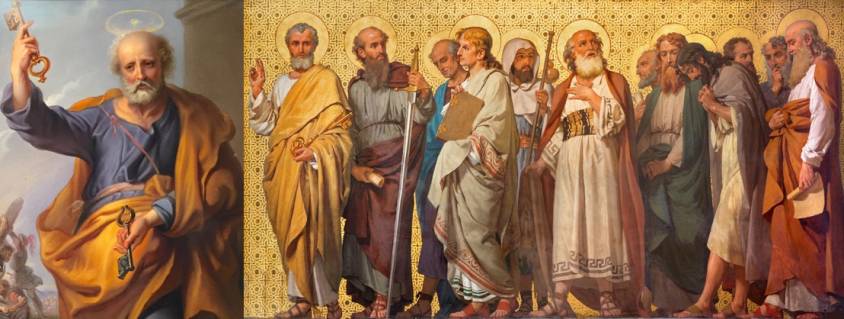
‘On this rock I will build my church!’ These are the words Yehshuwah spoke to Shimeyon, the chief among his disciples, about the church he was going to establish. If you wish to know which is the ‘rock’ that Yehshuwah spoke of, note this verse: “I say to you: You are Kepfa; on this rock I will build my church. The gates of the netherworld will not prevail against it” (Matthai: 16; 18). Yehshuwah said ‘You are Kepfa’ to the disciple whose name was Shimeyon. From that day onward he was called ‘Kepfa’! The meaning of the word ‘Kepfa’ is rock, or stone. Therefore, it is clear upon whom the church of Yehshuwah has been established! The Bible testifies that the apostles, Shauwul included, addressed Shimeyon as ‘Kepfa’. The name ‘Kepfa’ and the responsibility of leading the church were a great recognition that Shimeyon received from Yehshuwah. It was the confession of faith that Shimeyon made that qualified him for this recognition. What we must first know here is what that confession of faith was which pleased Yehshuwah. After that we may enter into the study concerning the church of Yehshuwah.
The event that clarifies the circumstance in which the disciple Shimeyon received the name ‘Kepfa’ is described in the Bible thus: “When Yehshuwah came to the region of Kesariya Philippi, he asked the disciples: Who do the people say the Son of Man is? They said: Some say Yohannan the Baptist, others say Yeliyah, and still others say Yiremiyah or one of the prophets. He asked them: But who do you say that I am? Shimeyon said: You are the Mshiyah (Christ), the Son of the living God. Yehshuwah said to him: Baryona Shimeyon, you are blessed! It was not flesh and blood, but my Father in heaven who revealed this to you. I say to you: You are Kepfa; on this rock I will build my church. The gates of the netherworld will not prevail against it. I will give you the keys of the Kingdom of Heaven. Whatever you bind on earth will be bound in heaven; whatever you loose on earth will be loosed in heaven. Then he commanded the disciples not to tell anyone that he was the Mshiyah” (Matthai: 16; 13-20).
When Yehshuwah asked the disciples who the people said the Son of Man was, they informed him of the opinions they had heard from the people. The disciples had heard some among the people say of Yehshuwah that he was Yohannan the Baptist raised up. While some were of the opinion that he was Yeliyah, others said that he was Yiremiyah or one of the prophets. However, no one said that Yehshuwah was the Mshiyah who is written of in the holy writings and for whom the Yisraelites were waiting in expectation! That is, Shimeyon alone recognized Yehshuwah in the condition in which he was! There is another verse that must be read here. That verse which Yehshuwah made known is this: “Eternal life is to know you, the one true God, and Yehshuwah Mshiyah whom you sent” (Yohannan: 17; 3). What one must fundamentally know in order to obtain eternal life — that is what Yehshuwah heard from Shimeyon! Shimeyon knew the one true God and his human incarnation, and he proclaimed that knowledge! What he proclaimed there that day is the real truth concerning eternal life! This proclamation set Shimeyon apart from the other disciples! And he received the name Kepfa!
There are many even today who acknowledge Yehshuwah as a prophet, as a historical figure, as a leader of renaissance, and as a great man. No one is regarded as excellent or inherits eternal life merely by giving Yehshuwah acknowledgements of this kind. Such descriptions are in reality not an honour to Yehshuwah but a dishonour! For it is like addressing the head of a nation as a member of local council! If one is to inherit eternal life, one must, like Shimeyon, accept and confess Yehshuwah Mshiyah in the condition in which he is.
It is when one acknowledges that Yehshuwah is the one true God, that this God came to the earth as a perfect man, that he offered himself as a sacrifice to give forgiveness of sins and salvation to all men who believe in him, that he is today the one God who holds all authority in heaven and on earth, that he will come again for the salvation of those who eagerly await him, that he will reign as king over all this earth for a thousand years, and that he himself executes the final judgment — it is then that one acknowledges Yehshuwah in the condition in which he is! Those who acknowledge Yehshuwah in this condition and receive baptism in his name obtain membership in his church! Only such persons are able to become members of his church! As long as one acknowledges Yehshuwah in this manner, one is a member of his church!
Whatever one must believe in order to become a member of the church of Yehshuwah — Shimeyon made a proclamation summarizing all of it in a single sentence. In the proclamation ‘You are the Mshiyah, the Son of the living God’, all the truths concerning the Son of Man are declared. For that is the very identity of the Mshiyah promised to Yisrael through the prophets! Every mission of the Mshiyah, from the incarnation of the one true God as man on the earth until the final judgment, has been made known to Yisrael beforehand through the prophets. The recognition that Yehshuwah is that Mshiyah is the first step toward entering into salvation! Considered in this sense, the first Christian is Shimeyon!
Shimeyon received from Yehshuwah a promise befitting the excellence of the confession of faith he made. Note once again what the promise of Yehshuwah was: “I say to you: You are Kepfa; on this rock I will build my church. The gates of the netherworld will not prevail against it” (Matthai: 16; 18). A promise is a declaration that something will be given in the future. That is, Yehshuwah declared that he would establish the church. This proclamation had a continuation. We see it after the resurrection of Yehshuwah. It was a proclamation entrusting the responsibility of building up and leading the church that was to be established upon the confession of faith of Kepfa! Before entrusting this responsibility, he also causes Kepfa to make one more proclamation.
Yohannan recorded that event thus: “When their breakfast was over, Yehshuwah asked Shimeyon, who is Kepfa: Shimeyon, son of Yohannan, do you love me more than these? He said: Yes, Heavenly Lord, you know that I love you. Yehshuwah said to him: Feed my sheep. A second time he asked: Shimeyon, son of Yohannan, do you love me? He said: Yes, Heavenly Lord, you know that I love you. He said: Feed my lambs. A third time he asked him: Shimeyon, son of Yohannan, do you love me? Because he asked him a third time whether he loved him, Kepfa was grieved. He said: Heavenly Lord, you know all things. You know that I love you. Yehshuwah said: Feed my lambs. Amen, amen, I say to you, when you were young you girded yourself and went where you wished. But when you grow old you will stretch out your hands and another will gird you and take you where you do not wish to go” (Yohannan: 21; 15-18). What we must understand from all this is that through Kepfa, Yehshuwah was clarifying how every Christian ought to be.
What we have understood here so far is the chronicle of the arrangements made in connection with the founding of the church of Yehshuwah before it was established. One is able to become part of the church that was to be established upon the confession of faith of Shimeyon only when one accepts that faith! It was also Shimeyon, that is Kepfa, who proclaimed with clarity how one may obtain salvation and become a member of the church, which is the community of those who have entered into salvation! Yehshuwah has permitted no one to make proclamations different from what Kepfa proclaimed! For it was Yehshuwah who gave Kepfa the authority to bind and to loose. Through the proclamation ‘Whatever you bind on earth will be bound in heaven’, what Yehshuwah did was to give an authority to Kepfa! Yehshuwah, who holds all authority in heaven and on earth, declared unequivocally that the church which Kepfa builds up on this earth will have the approval of heaven! This is an authority that Yehshuwah gave to Kepfa alone. What must we understand from this?
The recognition that Shimeyon, that is Kepfa, received was a recognition given to his confession of faith. If the one who bears charge of his church is one who stands firm in this faith, then those who become members of such a church will also be followers of the same faith. That is, Yehshuwah wanted for the building up and leading of his church not one with a lukewarm stand in faith, but one with a rigorous stand! Therefore, Yehshuwah was ready to make Shimeyon confess his faith three times over, to give him the name ‘Kepfa’, which means ‘rock’ or ‘stone’, and to declare that he would establish his church upon that rock. Whatever Kepfa proclaimed, that is the law of the church of Yehshuwah for all time! For it was Yehshuwah who conferred supreme authority upon the proclamation of Kepfa both on earth and in heaven! As we have understood, Yehshuwah is the one God who holds all authority in heaven and on earth! It is a certificate of approval from this God that Kepfa received!
In the verse we first read, Yehshuwah clarifies one thing to Kepfa. Yehshuwah clarified it as a response to Kepfa’s confession of faith. When Kepfa said that you are the Mshiyah, the Son of the living God, Yehshuwah the man made certain proclamations. Those proclamations are these: “Yehshuwah said to him: Baryona Shimeyon, you are blessed! It was not flesh and blood, but my Father in heaven who revealed this to you. I say to you: You are Kepfa; on this rock I will build my church. The gates of the netherworld will not prevail against it. I will give you the keys of the Kingdom of Heaven. Whatever you bind on earth will be bound in heaven; whatever you loose on earth will be loosed in heaven” (Matthai: 16; 17-19). The first among the proclamations of Yehshuwah is that it was the Father in heaven who revealed the truth to Shimeyon. If it was the God in heaven who revealed it, and if it was in consideration of this proclamation that Yehshuwah established his church upon Kepfa, then what Kepfa proclaimed is the everlasting law of that church! That is, Yehshuwah here assures us that this proclamation made by Shimeyon, that is Kepfa, has the complete approval of heaven. As far as a Christian and the church of Mshiyah are concerned, the assurance of Yehshuwah is supreme! Yehshuwah also clarifies here that every Christian must hold the proclamation of Kepfa to their heart, and that his church has no other teaching different from this proclamation!
Another proclamation that Yehshuwah made to Kepfa is that whatever you bind on earth will be bound in heaven! Through this proclamation Yehshuwah confirms that the church which Kepfa builds up will have approval in heaven as well. We know that the first Christian community came into being following the preaching of Kepfa. Note one important proclamation that Kepfa made in his first sermon: “Repent, and let everyone receive baptism in the name of Yehshuwah Mshiyah for the forgiveness of sins. You will receive the gift of the Holy Spirit” (Acts of the Apostles: 2; 38). The first Christian community is the community of those who received this proclamation of Kepfa as a call! What Kepfa bound on earth was bound in heaven also! Kepfa built up the church on this earth in union with Yehshuwah. Therefore, that church was a single community. At no time while it remained united with Yehshuwah did that change.
Concerning the church that was built up upon the teaching of Kepfa, this is what we read in the Bible: “He bore witness to them with many other words and exhorted them, saying, Save yourselves from this corrupt generation. Those who heard his word received baptism. On that very day about three thousand people joined them. They took part constantly and eagerly in the teaching of the apostles, in fellowship, in the breaking of bread, and in prayer. Awe came upon everyone. Many wonders and signs were done through the apostles. All who believed became one community and considered everything they had as common. They sold their properties and possessions and distributed to all according to need. With one mind they eagerly gathered together daily in the temple, broke bread from house to house, and shared food with simplicity of heart and gladness. They praised God and were favoured by all men. Yehshuwah added to their number daily those who were being saved” (Acts of the Apostles: 2; 40-47). This was the church that the apostles, under the leadership of Kepfa and in union with Yehshuwah, built up!
Whatever Yehshuwah commanded when he entrusted Kepfa with the charge of building up his church, the apostles worked without turning to the right or to the left from those commands. We can understand through the signs that Yehshuwah was with the church throughout those times. The greatest sign that Yehshuwah was with the church is that it remained in the condition of one shepherd and one fold! Moreover, until that time the gates of the netherworld had not even once prevailed against the church! We must know the truth that when one gathers with Yehshuwah there is no scattering, and when one gathers without him there is scattering. Note the words of Yehshuwah: “He who is not with me is my adversary. He who does not gather with me scatters” (Matthai: 12; 30). We must recognize the reality that as long as the apostolic church stood with Yehshuwah without deviating to the right or to the left, it was never scattered or divided. Division and scattering began with the rejection of Yehshuwah!
The Edict of Milan and the Taking Away of the Apostolic Church!
The greatest proof that the apostolic church established upon the rock which is Kepfa was taken away is the Edict of Milan! We know that the Edict of Milan took place in A.D. 313. This is the year in which the apostolic church completed two hundred and eighty years! The period of two hundred and eighty years has a particular significance. Seven years together make one sabbath year. When forty sabbath years are completed, 280 years are reached. That is, 280 years is equal to 40 sabbath years. If we take the history of divine fulfilments in the Bible, we can see an inseparable connection between them and the number 40. According to the Bible, the fiftieth year is the jubilee year. That is, Mosha commanded that the year which comes after seven sabbath years shall be a jubilee year for you! If we examine the Bible closely, we can understand that in each age there are forty jubilees. Here, one can also discern the presence of the number forty in the ending of each age.
It is the will of God that every ending should be connected with the number forty! This is a reality that can be understood when one studies the Bible attentively. The presence of the number forty can be discerned in all divine plans. Therefore, we must seriously consider the Edict of Milan, which took place in the very year in which the apostolic church completed 280 years. Even though those who made the edict did not know the significance of that year, we now know it.
If one asks why the connection between the age of the apostolic church and the Edict of Milan becomes serious, the answer is that here there is a sign of a fulfilment, that is, of an ending. That sign is the number forty. If the Edict of Milan took place when forty sabbath years were completed after the apostolic church was established, then we must understand that with it the distinctive existence of that church came to an end. That is, the apostolic church was thereby taken away!
His church is the community of those who gather together in the name of Yehshuwah! As we understood earlier, entry into the church established upon Kepfa becomes possible for one through receiving baptism in the name of Yehshuwah Mshiyah. When two or three gather together in his name, he will be in their midst. That is the fellowship of the apostolic church! If two or three assemble in anyone else’s name, it will not be the apostolic church! But if they gather together in the name of Yehshuwah Mshiyah, it will be the apostolic church! The head and the cornerstone of this church, built on the foundation which is the apostles and the prophets, is Mshiyah!
It was through their teachings, which had the approval of heaven, that Kepfa and his fellow apostles together built up and cared for the church. With the deviation from these teachings, the distinctive existence of that church ceased. Note the apostolic teaching: “I am astonished that you are so quickly abandoning the one who called you in the grace of Mshiyah and turning to a different gospel. In truth there is no other gospel; but there are some people who want to trouble you and pervert the gospel of Mshiyah. Even if we ourselves or an angel from heaven should preach to you a gospel different from what we preached to you, let him be accursed! As we said before, so now I say again: If anyone preaches to you anything other than the gospel you received, let him be accursed!” (Galatthiya: 1; 6-9).
It was by completely rejecting this warning of the apostolic church that the new-fangled teachers made their confession of faith at the Nikhya Synod. They rejected Yehshuwah Mshiyah, and in his place they installed the Iesus (IESUS) proposed by Constantine. It was following this synod that baptism in the name of Yehshuwah Mshiyah was abolished. Until then, believers had received baptism in the name of Yehshuwah Mshiyah. It was also at the Nikhya Synod that three persons were attributed to the one true God. It was after that the practice of giving baptism in the name of the Father, the Son and the Holy Spirit began. The baptism that does not speak the name Yehshuwah Mshiyah was initiated partly for the reason that the acceptability of Iesus would otherwise be lost. It was Kepfa who unequivocally proclaimed that baptism must be received in the name of Yehshuwah Mshiyah. The name in which the head of the church proclaimed on behalf of the church that baptism must be received — that name the new-fangled teachers rejected. With that, this church ceased to be the church of Kepfa.
Only those who receive baptism in the name of Yehshuwah Mshiyah can become members of the church of Yehshuwah established upon Kepfa. With the abolition of that baptism, the opportunity for men to become members of the church of Yehshuwah was denied. However, there is a message in the Bible that gives hope to the souls of those who, for reasons not their own, were unable to receive baptism in the name of Yehshuwah Mshiyah and who therefore died without becoming part of the apostolic church. It is the message concerning baptism for the dead. That message is recorded in the Bible thus: “Otherwise, what will those who receive baptism for the dead do? If the dead are not raised, why do these receive baptism on their behalf?” (1 Korinth: 15; 29). We are not entering now into the details of this message or into an analysis of baptism in the name of Yehshuwah Mshiyah. For another article with a broad description concerning baptism is being published shortly. Therefore, let us continue our study on the subject connected with the apostolic church itself.
As said before, the reality is that with the completion of forty sabbath years the apostolic church was taken away. The reason for this is that through the Nikhya Synod Yehshuwah Mshiyah was rejected and baptism in his name was abolished. We know that the head and the cornerstone of the apostolic church is Yehshuwah. Therefore, a community that has rejected Yehshuwah cannot be called the apostolic church. Moreover, through the abolition of baptism in the name of Yehshuwah Mshiyah, there ceased to be any who entered the apostolic church. For the entrance gate into the church is baptism in the name of Yehshuwah Mshiyah. It is this entrance gate that the community of teachers, who were the obedient servants of Constantine, shut! With the closing of the entrance gate, the apostolic church was naturally taken away. With the taking away of that church, which was established upon the confession of faith of Kepfa, what was opened was the Constantine church founded on Greek mythology! The most important of the decisions of the Nikhya Synod is that baptism in the name of Yehshuwah Mshiyah was prohibited. Since the decisions of this synod will be discussed in detail in the study that follows, the reason for prohibiting baptism is not noted here.
What we have understood here is the two hundred and eighty year history of the church before division and scattering. Although there were differences of opinion among the leaders of the church in word-based interpretations, at no time during that period was the church divided or scattered. It is a reality that at least a few deviated from the faith and went out. We can understand that such fallings away occurred even during the period of the human incarnation of Yehshuwah. Look at a revelation: “It is the Spirit that gives life; the body is of no avail. The words I have spoken to you are spirit and life. But there are some among you who do not believe. He knew from the beginning who they were and who it was that would betray him. He said: This is why I told you that no one can come to me unless it is granted him by the Father. After this, many of his disciples left him; they never walked with him again” (Yohannan: 6; 63-66).
What we have read here is the proof that many among those who heard the word directly from Yehshuwah and accepted his discipleship later abandoned the faith. Likewise, the Bible also records those who believed in Yehshuwah but were not ready to follow him. Note this revelation: “Even so, many even among the authorities believed in him. But out of fear of the Pharisees, lest they be expelled from the synagogue, none of them confessed it. They desired the praise of men more than the glory that comes from God” (Yohannan: 12; 42, 43). What we must understand from all this is that there were at all times those who deviated from the faith. This is the warning that the apostle Shauwul gives concerning such deviation: “Therefore, let him who thinks he stands take care lest he fall” (1 Korinth: 10; 12). This is a warning to be considered with great seriousness. For Satan prowls about to snatch away by any means those who have come into salvation. Note this warning also: “Be sober and watchful. Your enemy the devil prowls about like a roaring lion, seeking whom he may devour. Resist him, standing firm in the faith” (1 Kepfa: 5; 8, 9).
The Prophecy of Yiremiyah and the Edict of Milan!
The Edict of Milan and the Nikhya Synod that followed it are the developments that formed the basis for the taking away of the apostolic church. This taking away was the consequence of rejecting Yehshuwah, the foundation stone of the apostolic church. This event has a direct connection with the prophecy of Yiremiyah. The prophecy is this: “Has any nation changed its gods, even though they were false gods? But my people have forsaken their glory for that which is worthless. Be afraid and tremble, O heavens; be appalled; shudder greatly — Yahweh declares. For my people have committed two evils. They have forsaken me, the fountain of living water; and they have dug broken cisterns that cannot hold water” (Yiremiyah: 2; 11-13). Yiremiyah began to prophesy in B.C. 626. That is, the span of time between this prophecy and the Nikhya Synod is 950 years.
What we saw at the Nikhya Synod, which took place after the Edict of Milan, is the literal fulfilment of the prophecy of Yiremiyah. From the day Yiremiyah prophesied until the time before the Nikhya Synod, it cannot be understood that the people of God as a whole ever forsook their God. Individuals and families in Yisrael and in Yehuda often forsook Yahweh their God and served other gods. There is also in the Bible the history of certain communities in ancient Yisrael turning en masse to the worship of other gods. The making and worshipping of a calf by the people of Yisrael in the wilderness in the absence of Mosha is one example of that. Even so, in the history of Yisrael or of Yehuda it has not been recorded that their official leaders completely rejected their God through a proclamation. That is, as stated in the prophecy of Yiremiyah, the reality is that a history of changing their God did not take place in ancient Yisrael.
When we examine the history of Christians, the modern Yisrael, we are able to understand similar things. In the days from the time of the apostles until the Edict of Milan, Christians did not forsake Yehshuwah, their saviour and Heavenly Lord. It was by the very name Yehshuwah that they called upon God. Baptism too was given in the name of Yehshuwah Mshiyah. Furthermore, it is a noteworthy matter that among the 33 popes from Kepfa to Silvester the First, none officially removed the name Yehshuwah. However, at the Nikhya Synod convened by Constantine after the Edict of Milan, it happened. That is precisely why it is said that the Edict of Milan and the Nikhya Synod are connected with the fulfilment of the prophecy of Yiremiyah.
The church remained carefully in the faith that Kepfa proclaimed and in the ministries that Yehshuwah entrusted only until the Edict of Milan. What took place after this edict was twelve years of planning and conspiracy! When twelve years were completed, Constantine convened a synod and rejected Yehshuwah! It was at that assembly, known as the Nikhya Synod, that the Greek god Iesus (IESUS) was installed in the place of Yehshuwah! The prohibition of the true baptism in the name of Yehshuwah Mshiyah was the preparation for installing Iesus. Afterwards they removed Yehshuwah completely and installed Iesus in his place. A false history was composed by removing even the signs of the remnants of historical truths. In order to install Greek traditions in the place of Yehuda traditions, detective-like tales and the fabrication of history were indispensable. When true teaching ceases, truth falls into oblivion! Likewise, when falsehood is heard repeatedly, the mistaken notion that it is the truth becomes firmly fixed. This is how falsehood establishes its dominion in the world.
When Emperor Constantine declared that it was the son of Siyus, the chief god of the Greeks, who was born in Bethlehem of Yehuda, the Christian teachers of that time had no option other than to accept it. For with the proclamation of religious freedom through the Edict of Milan, Constantine had already brought the reins of the Christian religion into his own grasp! The fact that Constantine ventured to convene a synod on behalf of Christians is proof of this. Ordinarily, a synod is convened by the person holding the highest position in the church. We know that the one regarded as the highest-ranking person of the Christian church is the Pope. The Christian church had a Pope in those days as well! Silvester the First was the Pope of that time! It is a historical truth that this Pope did not even take part in the Nikhya Synod!
The Constantine Church and the Nikhya Creed!
Shimeyon, that is Kepfa, proved through his confession of faith that he was worthy to be the foundation stone of the apostolic church. It was as a reward for this confession of faith that Yehshuwah entrusted him with the important charge of building up the church and giving teaching to the children of the church. With the very first sermon of Kepfa, about three thousand Yehudim received baptism and became part of the church. Because it gathered together with Yehshuwah, the apostolic church was not scattered even once until the Nikhya Synod. Until then, the truths of faith proclaimed by Kepfa were the creed of the apostolic church. However, at that decisive juncture, a new creed was proclaimed at the Nikhya Synod, and Yehshuwah their Heavenly Lord was removed and the Iesus proposed by Constantine was installed. With that, the Constantine church was established in the place of the apostolic church. That was also the fulfilment of the prophecy of Yiremiyah.
A church established on the basis of a creed endures only as long as it holds fast to that creed. This is the basis not only in the matter of a church, but in the matter of any movement whatsoever. The confession of faith of Kepfa had the approval of Yehshuwah. Therefore, as long as it remained in the faith that Kepfa proclaimed, Yehshuwah protected that church from being scattered. However, the Constantine church, which deviated from the faith that Kepfa proclaimed, was scattered into many pieces, fulfilling the word! Today there are about forty-five thousand churches in the world in the name of ‘Iesus’, that is Jesus. We must recognize here how greatly the word has become a reality — that those who do not gather with Yehshuwah scatter. Do we need a greater sign than this to show that Yehshuwah is not in even one of the forty-five thousand pieces? Note once again the warning of Yehshuwah: “He who is not with me is my adversary. He who does not gather with me scatters” (Matthai: 12; 30).
Note the warning Shauwul gives, that if anyone preaches another Yehshuwah other than what the apostles preached under the leadership of Kepfa, it must not be accepted: “For if someone comes and preaches another Yehshuwah other than the one we preached, or if you receive another spirit other than the one you received, or another gospel other than the one you accepted, you will submit to all of it with ease” (2 Korinth: 11; 4). What was seen at the Nikhya Synod was an easy submission to the demonic. A creed that completely rejected the apostolic teachings was proclaimed at this synod! What was preached after the Nikhya Synod was not the Yehshuwah whom the apostles preached; rather, it was the Iesus proposed by Constantine. Thus not only the prophecy of Yiremiyah and the warning of Yehshuwah, but also the withdrawal from the apostolic teachings became a reality.
It was through twelve years of secret planning, from the Edict of Milan to the Nikhya Synod, that they created the false Mshiyah called ‘Iesus’. The reality is that many obscurities surrounding this synod persist even today. Manova may clarify here what those obscurities are.
For the twelve years from the Edict of Milan to the Nikhya Synod, and for ten years after it, it was Silvester the First who led the Christian community. He is also the only person with authority to convene a synod. However, not only was Silvester the First unwilling to convene the synod, he did not even participate in that obscure synod. This is the first obscurity concerning the Nikhya Synod! This very fact also invalidates the decisions of that synod! The ‘unusual’ relationship that Emperor Constantine had with the Spanish bishop who presided over this synod, ‘Hosiyus of Corduba’ (Hosius of Corduba), further increases the obscurity concerning the Nikhya Synod. It was this interest of the emperor that brought Hosiyus to the position of president of the synod. That Emperor Constantine was able to set aside Silvester the First, the Pope of that time, and make a bishop from Corduba in Spain the president of the synod, is proof of how politics had tightened its grip upon the Christian community with the Edict of Milan.
However, the interest of Constantine went beyond politics. Emperor Constantine’s closeness with Hosiyus was not merely for a political reason. Besides being one of the originators of the Nikhya Creed, which is contrary to the word and completely rejects the apostolic teachings, Hosiyus was also a person who upheld the ‘trinitarianism’ of Tertulyan, which the apostolic church had rejected. Emperor Constantine knew that friendship with Hosiyus would help him to alter the teachings of the church according to his own desire, and thereby to synthesize Greek demonic religion with Christianity.
We must here understand certain important subjects with clarity. Chief among them is the origin of trinitarianism and its evolution. Likewise, we must have a general understanding of the synods that took place before the Nikhya Synod. What we first try to understand here are the truths concerning the origin and evolution of trinitarianism. It was about fifty years after the death of the apostle Yohannan that a person named Tertulyan came forward with trinitarianism. Even in the period when the apostles were living, many had entered the scene with erroneous doctrines. However, the apostles worked with great vigilance so that believers would not be drawn to such ideas. The warnings of Shauwul in the letters written to the Galatthiyans and the Korinthians are proof of this. The apostles warned the children of the church that those who accept a Yehshuwah other than the one they preached, or gospels other than their own, would go astray. These admonitions are proof that erroneous doctrines had entered the church even in the period of the apostles.
The last of the apostles to die was Yohannan. That was at the end of the first century (about A.D. 100). After the death of Yohannan, the children of the church began to be drawn more and more to erroneous doctrines. Even so, in the period from A.D. 100 to A.D. 200, such ideas, which arose locally, did not gain universal influence. However, toward the end of that century ‘trinitarianism’ arose. This ‘trinitarianism’ was one among the many studies of Tertulyan, who was born between A.D. 155 and A.D. 160 and died after A.D. 220! He lived in the city of Carthage in North Africa (present-day Tunisia). Although some were drawn to the idea of Tertulyan, in those days such ideas did not receive the official approval of the church. That is, as we have understood before, the historical truth is that the church leadership of that time did not accept the arguments of Tertulyan. It was in order to reject such ideas contrary to the word that local synods were convened in those days.
The important ones among the local synods are the two synods held in Carthage. The first was before the Nikhya Synod and the second after it. It was with the aim of resolving the disputes that had arisen concerning baptism that a local synod was convened in Carthage in A.D. 256. Present-day Tunisia is the Carthage of that time. The one who presided over that synod was Cyprian, the bishop of Carthage. It was at another synod held at Carthage itself in A.D. 397 that the canon of the newer books of the Bible was fixed. It was then that the 27 books from the Gospel of Matthai to Revelation received approval. This synod too was a locally held synod. Nevertheless, this decision was universally accepted.
The one who led this synod was Augustin, the bishop of Hippo. He later came to be known as Saint Augustin of Hippo. Hippo Regius, where Augustin was bishop, is situated in the very same North African province in which Tertulyan had lived. Augustin was installed in the office of bishop when 71 years had been completed after the Nikhya Synod, at which the ‘trinitarianism’ brought in by Tertulyan was accepted. Augustin, who conducted intellectual researches concerning the trinity, is also a person who withdrew from that endeavour after failing. When studying the origin and evolution of trinitarianism, he can never be set aside. If we wish to know how the rejected ‘trinitarianism’ became acceptable, we must travel backwards once again. Our investigative journey is along the road from Tertulyan to the Nikhya Synod.
We have seen that Tertulyan is the person who raised ‘trinitarianism’ at the close of the third century. What is described as ‘trinitarianism’ is the doctrine that the one true God is not one, and that in God there are three persons — God the Father, God the Son, and God the Holy Spirit. It is a reality that many were attracted to this idea, which is contrary to the true gospel that the apostles of Yehshuwah preached. It was because it was propagated after the apostles had completed their ministry and entered paradise that many were deceived by this idea. Moreover, the absence of the opportunity to examine and verify the holy writings was also a reason why ideas contrary to the word gained acceptance. However, ideas denying the trinitarianism of Tertulyan were also propagated in those days. ‘Ariyanism’, which arose in the fourth century following the argument of Tertulyan, is an important one among them.
‘Ariyanism’ is the idea raised by Ariyus, a priest of Alexandria, in connection with the divinity of Yehshuwah. It was in A.D. 318 that this argument was widely propagated. Ariyus too accepts the argument, as Tertulyan argued, that the Father and the Son are separate persons. However, the main difference between the ideas of the two was that he does not accept Yehshuwah as God. Ariyus argues through his doctrine that Yehshuwah is only a creation of God, and that unlike God he is not without beginning. The reality we must understand here is that what these two persons raised were ideas contrary to the word. What Tertulyan argued was that Yehshuwah, who was incarnated on the earth as a perfect man, lived as perfect God and perfect man. However, even in those days there were in the church those who followed the apostolic teachings. They were not people who came to know the truth by reading the holy writings. Rather, they are those who remained in the truth by passing on the teachings of the apostles just as they were, orally, to succeeding generations!
As we understood before, local synods were convened in order to reject ideas contrary to the word that arose locally and to keep the children of the church joined to the truth. However, with the end of the period of the ministry of the apostles, propagation of ideas that were not confined to the local level took place among the children of the church. The important ones among the ideas contrary to the word that arose in this period are the trinitarianism of Tertulyan and the Ariyanism of Ariyus. Moreover, these ideas gained currency beyond the borders as well, and disputes took shape among the children of the church. It is in this situation that a decision was taken to convene a universal synod. That synod is the controversial synod known as the ‘Nikhya Synod’!
The Nikhya Synod was convened under the pretext of resolving Ariyanism, which had begun in the Alexandrian church. There is a reality we must recognize here. For while great disputes existed on two important subjects, a resolution in the matter of only one of them was part of an agenda. That agenda was to accept the trinitarian doctrine of Tertulyan and to declare that the Mshiyah lived on this earth as God and man! What they gave as explanations concerning the trinity were dry arguments that could not convince even the believers in the church. Trinitarianism, which was the very cause of a religion called Islam coming into being, remains even today an unanswered riddle. It is Tertulyan and Constantine who put the whole Christian community on the defensive, to such an extent that they stand bewildered before the three questions that Islam has been asking then and now.
Before entering into the details concerning the origin of the religion of Islam, a brief description of what the Nikhya Creed is must be given. What we saw was that at the Nikhya Synod the ideas of Tertulyan, which are contrary to the word, were adopted wholesale and proclaimed as the creed of the Christian community. The only good thing that happened at the Nikhya Synod is that Ariyanism was declared a heresy. However, the synod proclaimed trinitarianism, which is an equally great blasphemy, as the creed of Christians. That was a challenge against God. The greatest proof that it was a challenge against the God who has repeatedly declared that he is one and that he has no partner is the present condition of the very place where the Nikhya Synod was held. ‘Isnik’ (Isnik), which is today part of Turkey, is what was then known as ‘Nikhya’. In that place, where Christians were the great majority, one cannot today find even a single native Christian, apart from those who come as visitors from abroad! This is the present condition of the place chosen to challenge God.
What we see in the Nikhya Creed is a daring but futile attempt to establish that there are three persons in God. If a creed is to be confessed with full conviction, one must be able to grasp its meaning. If what is written on paper is read without grasping its meaning, it will not be a confession of faith. We must know one thing here. For it is this creed, which no one to this day has been able to grasp, that became the cause of the taking away of the apostolic church. No one can be part of the apostolic church while denying the truths that Kepfa confessed before Yehshuwah and that the apostles taught the people of God. The Nikhya Creed was fabricated by rejecting the prophetic writings which declare that the one called Father, Son and Holy Spirit is one and the same, and that he is Yehshuwah.
Note the prophecy of Yeshaiyah: “For to us a child is born. To us a son is given. The dominion will be on his shoulder; he will be called Wonderful Counsellor, Mighty God, Everlasting Father, King of Peace. On the throne of David and in his kingdom his dominion is boundless; his peace is endless. To establish and maintain it in justice and righteousness forever. The zeal of Yahweh of hosts will accomplish this” (Yeshaiyah: 9; 6, 7). Descriptions such as Father, Son and Holy Spirit have been given to one person. It is also clarified here that he is the Mighty God. Without any obscurity, God has revealed himself through Yeshaiyah in a manner that even a child can grasp. However, the trinitarian doctrine that Tertulyan and Constantine together imposed upon Christians was understood by no one. Therefore, they all migrated en masse into the religion of Islam!
Since even uttering on the lips the Nikhya Creed, which is entirely contrary to the word, is a defilement, Manova does not wish to defile anyone by writing it here. For those who recite the creed are proclaiming their own faith. That creed has been prepared by stuffing it with blasphemy in such a way that no one can readily understand it. Therefore, only the main decisions taken at the Nikhya Synod are noted here.
Trinitarianism established: The first decision of this synod was the declaration that Yehshuwah lived on this earth as perfect God and perfect man. That is, the creed that the Father and the Son are equal and of the same substance (homoousios) was officially accepted. In addition, Ariyanism was declared a heresy. This is a proclamation contrary to the word and directly opposed to the teachings of the apostles. The truth proclaimed by the holy writings is that Yehshuwah is the one true God and that he came to this earth as a perfect man. The teaching of the apostles was not different from this. Note the apostolic teaching that clarifies that Yehshuwah was a perfect man on this earth until his death on the cross: “Though he was in the condition of God, he did not regard equality with God as something to be maintained; but emptying himself, he took the condition of a servant and became like men, and being found in appearance as a man, he humbled himself, becoming obedient unto death — yes, unto death on the cross” (Philippi: 2; 6-8). No further proof than this is needed to understand that the Nikhya Synod was convened with the aim of denying the real truth concerning Yehshuwah and the teachings of the apostolic church!
The Nikhya Creed: Another decision of the synod was that in this creed the Christian faith concerning the Father, the Son and the Holy Spirit was recorded and proclaimed as the official faith of the Christian community. The very expression ‘these persons’ — Father, Son and Holy Spirit — may be seen as a declaration that they are not one. This decision invalidates the prophetic writing which says that the one called Father, Son and Holy Spirit is one and the same. The prophecy of Yeshaiyah is not repeated here. With the proclamation of the foolish argument that there are three persons in God as the official faith of the church, it was confirmed that the religion founded by Constantine has no connection whatsoever with the apostolic church!
Baptism: This synod decided to prohibit completely baptism in the name of Yehshuwah alone, and instead that baptism should be given in the name of the trinity. This was another demonic decision. Those who stand as admirers, eulogists and propagators of the Nikhya Synod must convince the believers what that name of the trinity is. No one has any doubt that Yehshuwah commanded that baptism be given in the name of the Father, the Son and the Holy Spirit. However, that name must be found. If the Father, the Son and the Holy Spirit are the trinity, what is the name of the trinity? The very word of Yehshuwah has clarified that it is one single name. The apostles knew clearly what that name was, which was made known through the prophets and directly by Yehshuwah.
Besides clarifying to the disciple Peelippo that he and the Father are one, Yehshuwah the Son of Man also clarified that what he bears is the name of the Father which the Father gave him. Note the words of Yehshuwah: “While I was with them, I protected them in your name which you gave me; I kept them safe” (Yohannan: 17; 12). It is clarified here that what Yehshuwah bears is the very name he bore when he was God in heaven. The meaning of the name Yehshuwah is ‘Yahweh saves’. The name Yehshuwah has a connection with his mission.
The name Yehshuwah is the one and only name given for salvation. The apostles knew that the one who is Father, Son and Holy Spirit is Yehshuwah, and that baptism must be given in this name. That is why, when he was filled with the Holy Spirit, Kepfa cried out thus: “Kepfa said: Repent, and let everyone receive baptism in the name of Yehshuwah Mshiyah for the forgiveness of sins. You will receive the gift of the Holy Spirit. This promise is for you and for your children and for those far off and for all whom Yahweh our God calls to himself” (Acts of the Apostles: 2; 38, 39). Baptism must be received in the name of Yehshuwah Mshiyah. A baptism not in this name is not valid! We can see that when the apostles visited certain communities of believers, they commanded those who had received baptisms not in the name of Yehshuwah to receive baptism in this name.
It is recorded in the Bible thus: “He asked: Then what baptism did you receive? They said: The baptism of Yohannan. Then Shauwul said: Yohannan gave the baptism of repentance, exhorting the people to believe in the one who was to come after him, that is, in Yehshuwah. Hearing this, they received baptism in the name of the Heavenly Lord Yehshuwah” (Acts of the Apostles: 19; 3-5). This clarifies the importance of baptism in the name of Yehshuwah Mshiyah and the will of God. This was how one became a member of the apostolic church. With the prohibition of this baptism, no one had the opportunity to join the apostolic church! Since the teachings and other explanations connected with this have been given at the beginning, they are not repeated again.
If baptism in the name of Yehshuwah Mshiyah was completely prohibited with the Nikhya Synod, then the reality we must recognize here is that the baptisms given after that are invalid. Only those who receive baptism in the name of Yehshuwah can become members of the apostolic church. That is, after the Nikhya Synod not even one person has been added to the apostolic church.
The rehabilitation of Christians: The persecution of Christians in the Roman Empire was brought to an end, and it was decided to receive back into the church those who had fled from the persecutions and those who had drifted away from the faith. This is another decision taken by the Nikhya Synod. That Christian persecution in the Roman Empire ended with the Edict of Milan is a falsehood that has been propagated for ages. There is no dispute that such a common perception was created in the world. However, the reality is that after the Nikhya Synod the persecution of Christians became more severe. If we examine what the rehabilitation of Christians implemented according to the decision of the Nikhya Synod actually was, we can recognize this truth. The rehabilitation of Christians was the act of imposing the Nikhya Creed upon all Christians. Those who followed different ideas could confess the Nikhya Creed and become part of the Constantine church. Those who came in this way would not have to suffer persecutions!
There was one more condition for the rehabilitation of Christians. That condition was that those who had earlier received baptism in the name of Yehshuwah Mshiyah must receive re-baptism in the name of the trinity. That is, only those who come having completely rejected the apostolic traditions are able to become part of the new church. Is any further proof needed to recognize that what took place at Nikhya was a synod that invalidated all the apostles, Kepfa included? It was the true saints, who received baptism in the name of Yehshuwah Mshiyah and became courageous martyrs, whom the teachers who were the obedient servants and eulogists of Emperor Constantine placed under the shadow of suspicion. We must recognize a truth here. For only those who rejected the traditions of the apostolic church and came over to the tradition of the Nikhya church, founded on Greek demonic religion, obtained release from persecutions. Re-baptism in the name of the trinity was a matter that caused great disputes in those days. If history is subjected to a re-reading and to word-based analysis, all these truths can be grasped.
Episcopal authority: Consolidating the authority in the main cities of Rome, Alexandria and Anthyokhya, and increasing the authority of the bishops, was an important decision of the Nikhya Synod. They needed this excessive authority to impose their political interests and their erroneous spiritual teachings upon the believers. Although all believers were part of the royal priesthood, this change was implemented by restricting the priesthood as the seat of authority of a particular group. In course of time, this priestly system gained greater strength, and the relationship between believers and priests became like the relationship between landlord and tenant.
Political and spiritual give-and-take took place between the emperors and the priesthood. While the emperors gave wealth and facilities to the priesthood, the priesthood repaid it by declaring the wives and relatives of the emperors to be saints. The office of the Pope and the office of the emperor, which proceeded in mutual cooperation, turned the church leadership into synonyms for arrogance. In order to keep the believers forever under their command, they twisted and taught the word of God. While all who received the Holy Spirit are anointed ones, they twisted the word in order to mislead the believers into thinking that the status of the anointed is reserved for the priestly system alone. By making people believe that when God said ‘Do not touch my anointed’ he was speaking about them, the priesthood succeeded in keeping the believers as their slaves.
‘Do not touch my anointed’ is the word that God spoke through Mosha to the nations that came to wage war against the people of Yisrael who journeyed from Egypt to the land of Canaan. The reality is that the priesthood misused this word for their own self- importance. There also existed the practice of branding as ‘heretics’ and expelling from the church all who questioned the ideas of the church teachers that were contrary to the word. They also excommunicated those who accepted the ideas of those accused of heresy. Although many persons came forward who ventured to reveal word-based truths, the truths they cried out were suppressed by declaring them heresy. Moreover, those regarded today as fathers of the church are not the apostles or those who followed their teachings. Rather, they are those who came after the Nikhya Synod and those who follow that creed. That is, the Christian communities of today have only a tradition of 1700 years.
Easter Day: It was at this synod that the decision was taken to unify the date for celebrating Easter Day and to prepare a calendar. Behind this decision, which at first glance may appear praiseworthy, there is a hidden trap. That trap was prepared with the aim of shifting the observance of the sabbath — which ancient Yisrael observed on the basis of the law of Mosha and which the apostolic church followed — from Saturday to Sunday, the day of the sun god (Siyus) who was the chief god of Constantine. Time later proved this. The apostles did not encourage the observance of any days or months other than the sabbath. If we examine the letters of the apostles, this matter becomes clear.
Note the reference in the letter the apostle Shauwul wrote to the Galatthiyans: “You are observing days and months and seasons and years! I fear that my labour among you may have been in vain” (Galatthiya: 4; 10, 11). Christians are neither called nor sent to observe days and months and seasons and years. Apart from the sabbath and the Pesaha, the apostles encouraged no other observances! Only when we remain in the apostolic teachings are we part of the apostolic church. Therefore, with the fall into the trap prepared by the ‘Trojan horse’ called Constantine, the apostolic church was taken away. We must recognize that the fixing of a day to celebrate Easter was not out of Constantine’s love for Yehshuwah, but so that the memory of his own god might not fade away. That is, when imposing Iesus, which means ‘blessed Siyus’, upon Christians, it was indispensable for Constantine also to impose Sunday, the day of the sun!
The testimony that history gives is that this synod turned out to be the greatest harm that Constantine did to humankind. For it was at this synod that the true God was replaced and a false god was imposed upon Christians. What Constantine presented was a god whom the apostles had neither seen nor heard of. They abolished baptism in the name of Yehshuwah Mshiyah, in whose name the apostles gave baptism. With the removal of the name Yehshuwah, a baptism without speaking the name was established. Thus the prophecy of Yiremiyah, which we read earlier, was fulfilled. If it is said that the beginning of all the disasters that gripped Christianity is the Nikhya Synod, that is the truth! Therefore, the Nikhya Synod may be described as the synod of betrayal.
The Nikhya Synod and the Religion of Islam!
We have seen that it was through the Nikhya Synod that Iesus was installed in the place of Yehshuwah, the true God. With that, the Constantine church not only degenerated into a crowd that had lost its protection, but those who had until then been a single community were also scattered. What history witnessed thereafter was the sight of the warning given by Yehshuwah — “He who gathers without me scatters” — becoming a reality. Likewise, in Anthyokhya and Alexandria, the seats of authority established in the East according to the decision of the Nikhya Synod, the Constantine church was annihilated to the point that not even one believer remained. The religion that was established in its place is Islam.
In reality, the religion of Islam may be seen as the retribution that God sent against the Constantine church. For it was by questioning the Nikhya Creed that the religion of Islam grew in the East. The reality is that the new church built by Constantine is unable even today to answer the questions that Islam raised in the East in those days. Three questions to which the apostolic church has an answer and the Constantine church has no answer are what Islam raises even today. Manova may clarify what those questions are and why the Constantine church is unable to give an answer.
The Questions Islam Raises!
Although there are numerous questions that Islam raises against the Constantine church, established after the Nikhya Synod, all of them can be reduced to three main ideas. For all the questions of Islam rest upon three main ideas. They may, if one wishes, be described as root questions. Which are those root questions?
Question one: The first among the root questions that Islam raises against Christianity is connected with belief in one God. Through this, Islam questions the three persons of the trinity propagated on the basis of the Nikhya Creed. They also say that the trinity is nowhere mentioned in the Bible. The plain fact is that the teachers of the Constantine church have not to this day been able to convince even their own followers concerning the trinitarian doctrine created contrary to the word. Therefore, no Islamic-Christian debater has to this day given a clear answer to this question raised by Islam. Although in the early period the teachers conducted many researches on this subject, either because they did not examine the holy writings or because they were unable to grasp them, all their researches were abandoned halfway. It is natural that Tertulyan, Ariyus and Augustin failed in trying to search out and discover it by their own intellect.
For it is written thus: “Yehshuwah proclaimed: Father, Heavenly Lord of heaven and earth, I praise you because you have hidden these things from the wise and the prudent and revealed them to little children” (Matthai: 11; 25). What they tried to search out and discover by intellect is a truth that has been written in such a way that even children can understand it when they read it. Manova may clarify one thing here. For although the word trinity is not recorded in the Bible, one can understand that there is a trinitarian condition in God. That trinitarian condition is not the trinity that Tertulyan, Ariyus and Augustin teach; rather, it is the image of himself that God revealed when he created the first man.
Note the word of God: “God said again: Let us make man in our image and likeness. Let them have dominion over the fish of the sea and the birds of the air and the cattle and over all the earth and over every creature that crawls on the earth. So God created man in his image; in his image God created him; male and female he created them” (Creation: 1; 26, 27). The trinity is the image of God! When he created the birds or the animals or other creatures, God did not say, Let us make them in our image and likeness. What sets man apart from the other creatures is that God gave him his image. What is the distinctiveness of man that other living beings do not have? That distinctiveness is that man has a body, a mind and a spirit. Since this subject has been discussed in many other articles, we are not entering now into the details of the trinity. Nevertheless, one thing must be clarified here. That is, by making the trinitarian aspect, which can be understood very simply, into something highly complex, and by attributing three persons to God, the Nikhya Synod committed a great offence against God and against men!
The teachers continue even today to deceive the believers by saying that the Father, the Son and the Holy Spirit are three persons and that this is a great mystery which man cannot grasp. However, some who did not accept this counterfeit doctrine upheld belief in one God. It was from these that Muhammad obtained the idea of Islam. The religion of Islam is what Muhammad established by expanding the idea he received from the dissenters within the Constantine church. That is, had there been no Tertulyan and no Nikhya Synod, a religion called Islam would not have been established. For the God of the apostolic church is one; his name is Yehshuwah! There are many verses in the Bible that clarify that there are not three persons in God, and that the one called Father, Son and Holy Spirit is Yehshuwah. Besides what is recorded in the prophecy of Yeshaiyah, we have understood it also through the words of Yehshuwah.
Question two: Another critical question that Islam raises is against the divinity of Yehshuwah. They ask that if Yehshuwah was perfect God, how did he die. It is Tertulyan and the Nikhya Creed that gave Islam the opportunity to raise this question. It is because the Constantine church concealed the truth that ‘Yehshuwah’ is the God of heaven, who, while maintaining his divinity in heaven itself, was incarnated on this earth as a perfect man, that the occasion for such a question arose. Since the biblical message that clearly reveals Yehshuwah, who was incarnated on this earth as a perfect man, has been analysed earlier, it is not repeated here. What we read there was the message that clarifies that Yehshuwah lived as a perfect man until his death on the cross. Note another revelation of Shauwul: “Yehshuwah, who was made a little lower than the angels in order to embrace death, became subject to death and was seen crowned with glory and honour” (Hebrayar: 2; 9).
Yehshuwah came to this earth to offer his body as a sacrifice of atonement for sin. Since man himself had to make atonement for the sin that man committed, Yehshuwah came as a perfect man. Moreover, while the condition of God remains, death is not possible. Since there is no death for God or for the angels of God, he came as one made a little lower than the angels. It is this reality that the apostle Shauwul clarified through the wisdom he received. This is the faith that the apostolic church followed. The reality is that when the apostolic teachings were rejected wholesale and new teachings were presented, the Nikhya churches became those who had lost their power of defence before their adversaries. However, because the apostolic church proclaimed the real truth, this question was never once raised by anyone until the Nikhya Synod!
Question three: The third question of Islam is against the divine sonship of Yehshuwah. Islam argues that Yehshuwah is only a prophet and that he must not be called the Son of God. Although Islam raises these criticisms against the Iesus proclaimed at the Nikhya Synod, what they mean is Yehshuwah Mshiyah himself. There are two reasons why such a criticism arises from Islam. If the first reason is the ignorance of Islam concerning divine sonship, the second reason is the Nikhya Creed itself. Manova may explain both these reasons here.
The reason for the ignorance of Islam concerning divine sonship is the mistaken notion they hold concerning the God-man relationship. What Muhammad passed on to his followers is only the limited knowledge he obtained concerning God and concerning man who was created by God. Muhammad received knowledge concerning the God of Yisrael, in whom Christians believe, from the Christians of Syria. Syria was one of the main centres of Christians. It is natural that Muhammad, who frequently visited Syria in connection with trade, would form friendships with the Christians there. Through that connection Muhammad obtained a preliminary knowledge concerning Christianity and their God. It was Muhammad’s custom in those days to visit the Christian ‘monasteries’ (hermitages) in Syria and the surrounding regions. In those days ‘monasteries’ were built by boring into mountains in a manner resembling caves. Those who visit Cappadocia in Turkey can see these ‘monasteries’ directly. The ‘Cave of Hira’, in which Muhammad is said to have received the Quran by recitation, is these very ‘monasteries’.
It was from the monastery that Muhammad calls the ‘Cave of Hira’ that he obtained the idea of establishing the religion of Islam. The Christian ascetics passed on to Muhammad, orally, the knowledge that had been passed on to them orally. Muhammad, who was without letters, had no need of knowledge in written form. That is, the knowledge Muhammad obtained concerning God and concerning the God-man relationship was only what he received through hearing. And that, moreover, was on the basis of the Nikhya Creed. Furthermore, all this happened at a time when great disputes had arisen among Christians. The important one among the disputes that existed then was connected with the trinity. Many tried to give definitions to the trinity. The interpretation that the trinity is Yosef, Mariyam and Iesus was also widely propagated in those days. Muhammad was aware of all these disputes among Christians. All these matters are referred to in the Quran which he dictated and had written down.
That it is recorded in the Quran that Christians have three gods and that one of them is a female god is on the basis of the distorted knowledge obtained from the beliefs contrary to the word that were current among Christians. Note an ayat in the Quran: “And (mention) when Allah says: O Eesa, son of Mariyam, did you say to the people, Take me and my mother as gods besides Allah? He will say: Glory be to you! It is not for me to say what I have no right to say. Had I said it, you would surely have known it. You know what is in my mind, but I do not know what is in your mind. Indeed, it is you who are the knower of the unseen” (Quran: 5; 116).
The ayat we have read here is Allah asking Eesa Nabi, and Eesa giving his reply to it. Allah asks Eesa whether it was Eesa who instructed the people to take him (Eesa) and his mother (the mother of Eesa) as gods. Eesa replies that he never thought so even in his mind. We know that the words of Allah and of Eesa are the imagination of Muhammad. Nevertheless, Muhammad said this following one of the disputes in the Constantine church. Muhammad knew those who argued that Iesus, Mariyam and Yosef were the trinity. He mistakenly assumed that what he had come to know was the real teaching of Christianity. The religion of Islam is what was patched together by putting together many misunderstandings of this kind. The ‘trinitarian notion’ of ‘Eesho, Mariyam, Yousepp’ (Iesus, Mariyam, Yosef) which the Suriyanis of Kerala received also comes from this same heresy! This is proof that this ‘heresy’ was widely propagated in the Anthyokhyan regions and that it influenced many.
The reality is that Muhammad had no information whatsoever concerning the teachings given by the apostles of Yehshuwah. The knowledge that Muhammad had concerning the God-man relationship was also what he received from the Constantine church. No one told Muhammad that the man whom God created in his image was the son of God, that through disobedience he lost his status as son of God, and that God was incarnated as man in order to recover and restore that status of divine sonship! That is why he lacked the knowledge to understand that all men without sin are children of God.
Just as Adam was a son of God when he was created in a condition without sin, so also Yehshuwah, who was born without sin and who did not commit sin until death, was the Son of God. Likewise, all who believe in Yehshuwah and receive baptism in his name are able to become children of God. Note a verse in the Bible: “But to all who received him, to all who believe in his name, he gave the power to become children of God” (Yohannan: 1; 12).
What we have examined here are the root questions that Islam raises. Through this examination there is a truth we can understand. For all the arrows of Islam’s questioning fall upon the churches built up on the Nikhya Creed. Not even one of the arrows of Islam’s questioning has fallen upon the church of Yehshuwah, which was built up on the foundation which is the apostles and the prophets. That is, the religion of Islam arose not against the apostolic church, but against the Constantine church. The religion of Islam may also be seen as the retribution that God sent against the Nikhya Synod and the Constantine church. If it is proclaimed what happened in Christianity and what real Christianity is, no one need be astonished that the adherents of Islam will think, find the sign, and come over to Christianity en masse! For it is the advocates of the Nikhya Creed who concealed the real truth from them.
If the apostolic church was never on the defensive in matters of doctrine, it is because it confessed Yehshuwah as the one true God and stood firm in the teachings of the apostles. That was also the fear of the gentiles. It was because they could not confront it in doctrine that the adversaries tried to destroy the doctrine by confronting it physically. Another reason for the fear of the gentiles was the name Yehshuwah which the apostolic church bore. Therefore, the gentile rulers forbade the apostles to speak in the name Yehshuwah. Note this revelation: “They called them and commanded them not to speak or teach anything at all in the name of Yehshuwah” (Acts of the Apostles: 4; 18). Note also the reply that Kepfa gave to those who commanded them not to speak in the name of Yehshuwah: “Kepfa and Yohannan answered them: Is it right in the sight of God to obey you rather than God? Judge for yourselves” (Acts of the Apostles: 4; 19).
The apostles were not those who obeyed man rather than God. They held fast to the saving name Yehshuwah. The reality is that this was pleasing to God. It was as a recognition of the confession of faith of Shimeyon, that is Kepfa, that Yehshuwah entrusted him with the leadership of the mission of building up his church and giving teaching to the children of the church. It was Yehshuwah himself who protected from scattering the church that the apostles built up under the leadership of Kepfa. At no time while it remained in the teachings of the apostles did the gates of the netherworld prevail against that church. However, when those teachings were rejected, the Constantine church was scattered into forty-five thousand pieces, fulfilling the warning that Yehshuwah gave! For those who think, there is a sign!
Forty-Five Thousand Constantine Churches!
There is a question as to how the Nikhya Creed, which is contrary to the truths of the word, so easily became the faith of Christians. The answer to this pertinent question is very simple. The opportunity for ordinary people to recognize what was contrary to the word in the teachings given by the spiritual teachers was very limited in those days. It was not a time, as today, when there was the opportunity to examine the Bible and verify. Copies of the prophetic writings, or copies of the instructional letters written by the apostles, were not available in every region. The method followed in those days was copying by hand. Moreover, the method of copying by hand was very costly and required much time.
In the early period of Christianity, what were mainly used for writing were papyrus scrolls and leather scrolls. The paper-like surface made from the papyrus plant of Egypt gained great currency in ancient Egypt, Greece and Rome. Leather scrolls made from the skins of animals were firmer and more durable than papyrus. However, since these were very costly, they gained greater currency in Europe. The letters of the apostles too were composed on such scrolls. Therefore, naturally, their handwritten copies were available only in very small numbers. For that very reason, destroying the writings in order to create a false history was not a matter of great difficulty. It was in this manner that the original Hebrew composition of the newer books of the Bible was destroyed and the Greek translation was established as the original work.
The Hebrew writings were an obstacle to the complete Hellenization that concealed the Hebrew background and foundation of Christianity. Therefore, the preliminary measures for Hellenizing Christianity were adopted by the group of Constantine within the twelve years from the Edict of Milan to the Nikhya Synod itself. It is a historical reality that after the Nikhya Synod a ban was imposed on Hebrew works. Although the synod did not directly ban Hebrew works, the Roman rulers and the church that came after it adopted policies that paved the way for it.
There are mainly three reasons why works composed in the Hebrew language were done away with. One of them is the Hellenization of the Christian religion. Emperor Constantine and the church had tried to remove the Hebrew roots of Christianity and to create a new Greek-based culture. As part of that, works in the Hebrew language and works with a Yehuda background were gradually eliminated.
Another reason why Hebrew works were done away with is the restrictions against the Yehudim. By the fourth century, restrictions against the Yehudim increased in the Roman Empire. Numerous laws and teachings separating Christians and Yehudim were implemented. This separation became an obstacle to the currency of Hebrew works. Another reason is the efforts made to alter the traditions. The church decided to separate Christian observances completely from Yehuda traditions. For example, the Nikhya Synod directed that Easter Day be celebrated differently from the Pesaha day of the Yehudim.
It is such circumstances that became the cause for imposing a ban on Hebrew works. This ban was not an isolated event; rather, it was part of a process by which Hebrew writings were gradually distanced from the Christian community. No one can deny these historical truths. The destruction of the Hebrew originals of the books from the Gospel of Matthai to Revelation was also with the aim of Hellenization. All the books regarded as part of the newer books of the Bible were composed in the Hebrew language. All of them were destroyed in the fourth century. If this was not a planned move, why did the writings connected with Christianity disappear without even one remaining? Were the apostles and the early believers not Hebrews? We must understand one thing here. For there was nothing under the Roman Empire that could not be accomplished if the emperor and the leaders of the Christian religion stood together.
Great conspiracies took place in the fourth century to remove the real teachings of the apostolic church from the believers. Branding as heretics and excommunicating those who spoke the truth and those who questioned what was contrary to the word was part of this conspiracy. Along with that, the believers were induced to honour, under the name fathers of the church, those who fabricated tales contrary to the apostolic teachings. What is propagated today as the tradition of the forefathers are traditions based on these fabricated tales and distorted interpretations. That is, what the Christian communities of today follow is a tradition contrary to the word, falsely created by rejecting completely the teachings of the apostles. Therefore, not even one of the more than forty-five thousand pieces scattered today is regarded as part of the real apostolic church.
With the abandonment of Yehshuwah and the adoption of Iesus, the splitting of the Constantine church began before long. With the division of the Roman Empire in A.D. 395, communication and cooperation between East and West decreased and discord arose. While the Eastern church (the Oriental church) considered Greek for worship, the Western church (the Occidental church) considered Latin. This caused the cultural distance between the two sections to increase. Another reason that led to the division of the Constantine church is the dispute concerning the supreme authority of the Pope. Before entering into the details of this dispute, we must understand the structure of the Constantine church.
After the Nikhya Synod, the Constantine church had three seats of authority. According to the decision of the Nikhya Synod held in A.D. 325, patriarchates (seats of authority) were established for the new church at Anthyokhya, Alexandria and Rome. According to the decision of the Synod of Constantinople in A.D. 389, Constantinople received the appellation New Rome and was declared the second seat of authority after Rome. Subsequently, according to the decision of the Synod of Kalkkidon in A.D. 451, Yerushalem was raised to a patriarchate. The head of a patriarchate was known as the patriarch. Even before all these took place, the Roman Empire had split in A.D. 395. The Byzantine Empire was established with Constantinople as its centre. This was also known as the Eastern Roman Empire. After the division, the empire established with Rome as its centre was called the Western Roman Empire.
It was through the laws of Justinian the First, who was the emperor of the Eastern Roman Empire (the Byzantine Empire) from A.D. 527 to A.D. 565, that this church system with five centres was made more official. That is, Rome, Constantinople, Alexandria, Anthyokhya and Yerushalem were known by the end of the fifth century as the most important seats of authority in the Constantine church. Nevertheless, this system received complete official approval only in the seventh century, that is, at the Council in Trullo held in A.D. 692. This was known as the formation of the Pentarchy.
Although the Roman Empire was divided, a Western-Eastern division had not taken place in the Constantine church at that time. However, with the conclusion of the Nikhya Synod, disputes arose in the church in the East and divisions began. In A.D. 431, Nestoriyus, who was the patriarch of Constantinople, came forward opposing the decisions of the Synod of Ephesos. That was following the declaration of Mariyam, who was the mother of Yehshuwah the Son of Man, as the Mother of God. It was Nestoriyus who opposed this declaration, which is contrary to the real truths of the word concerning the Mshiyah.
The very weapon that the teachers of the Constantine church constantly employ against those who oppose their demonic ideas was employed against Nestoriyus as well. The name of the weapon that has been employed from A.D. 325 until today is ‘heresy’. It was because he spoke the truth that Nestoriyus was declared a heretic and his argument a heresy. As a result of the accusation of ‘heresy’, the Nestorian section separated from the Constantine church. Afterwards they fled to eastern Syria and to Persia. It is they who came to be known in later times as the Nestorian church.
If a person is declared a heretic, he will be completely isolated in society. The condition of an idea accused of ‘heresy’ is also the same. The practice in those days was that if any of the believers associated with or assisted those declared heretics, those believers too were excommunicated. Therefore, ideas contrary to the word and evil practices continued to be installed in the Constantine church without being questioned. That is how the mother of the Son of Man became the Mother of God! Because he accepted certain truths concerning the Mshiyah and opposed the declaration of Mariyam as the Mother of God, it cannot be said that all the arguments of Nestoriyus were word-based. For Nestoriyus was a person who accepted the Nikhya Creed! No one who opposes baptism in the name of Yehshuwah can be part of the apostolic church.
The reason Nestoriyus opposed the divine motherhood of Mariyam is that he was able to interpret with clarity the divinity and the humanity of the Christ. Nestoriyus argued that the Christ is one who came to the earth as a perfect man. Therefore, what Nestoriyus said — that Mariyam can be regarded only as the mother of the Christ, the Son of Man — is completely true. He said that it is not wrong to call Mariyam the mother of the Christ, but that she must not be called the Mother of God. Although we can accept this teaching, which stands close to the real truth, we cannot accept an idea that supports baptism on the basis of the Nikhya Creed and accepts Iesus in the place of Yehshuwah. That is, the Nestorian church can be seen only as a sub-component of the Constantine church.
If the Nestorian church came into being by opposing the synod at Ephesos, the ‘Oriental Orthodox churches’ came into being by opposing the decisions of the Synod of Kalkkidon in A.D. 451. Disputes concerning the humanity and the divinity of Iesus were the cause of this new division. Following this, certain sections that did not accept the Synod of Kalkkidon separated from the main component of the Constantine church. The Coptic, Ethiopian, Syriac and Armenian Orthodox churches that came into being through that separation are together called the ‘Oriental Orthodox churches’. Although these splits were not like the East-West Schism of A.D. 1054, they caused great damage to the unity of the Constantine church.
It was in A.D. 1054 that the Constantine church split down the middle. That split was into Western and Eastern. The discords that took shape with the splitting of the Roman Empire grew into the vertical split of the Constantine church. Four of the five patriarchates of the Constantine church became part of the Eastern church, and Rome alone remained in the Western church. The reality is that even before this split, all the patriarchates in the East had already faced collapse. That happened with the growth of Islam in the seventh century. In A.D. 637 the army of Caliph Umar captured Yerushalem. It was with that that the authority and influence of the patriarchate of Yerushalem faded. Christians there were counted as second-class citizens.
Later, at the time of the Crusades, the patriarchate of Yerushalem gained strength again, but under Islamic rule its importance had diminished exceedingly. The condition of the patriarchates of Alexandria and Anthyokhya was no different. However, the authority of the patriarchate there endured until, in A.D. 1453, the Ottoman army captured the city of Constantinople and made Hagia Sophia a mosque of Islam. Afterwards that too declined. Today only the skeleton of the Constantine church remains in the East.
The greatest division that took place after the East-West division is the Protestant Reformation carried out in A.D. 1517 under the leadership of Martin Luther and John Calvin. Although this basically occurred within the Roman Catholic Church, it accelerated the scattering of the Constantine church into many thousands of pieces at the global level. The division that took place subsequently in the Roman Catholic Church was the Anglican division. Although this was established to protect the selfish interests of the British royal family, they claim that the Anglican church has about 85 million believers across 165 countries. The ‘Anglican Church, that is, the Church of England’ is what the royal family established in protest when the Roman Catholic Church did not permit King Henry the Eighth to contract another marriage while his wife was living! Many local churches, including CSI, CNI and Marthoma, follow the Anglican tradition. This is another version of the scattering.
If the Constantine church ceased to exist in the very place where Yehshuwah was abandoned, no one need be astonished at that. We must know that when Yehshuwah said ‘The gates of the netherworld will not prevail against it’, it was not in the matter of the Constantine church, but in the matter of the apostolic church established upon the confession of faith of Kepfa and upon the teachings of the apostles. Had it been otherwise, God would have left someone in the land where the Nikhya Creed was established. The remnants of the Christianity that was there are today in a museum. It stands there as a gruesome sign for visitors. If anyone is ready to take the annihilation that took place in the East and the scattering at the global level as a lesson, the apostolic church is not far from them! Its distance is only as far as the Nikhya Synod.
In connection with the scattering of the Constantine church, one more subject must be pointed out here. It concerns the evil practice of declaring saints. The practice that the Constantine church began, of exalting as saints after death those who declare humble submission to the ideas contrary to the word that they establish, has also paved the way for the division of that church. While the authority to judge belongs to Yehshuwah alone, the pronouncement of judgment that is the declaring of saints must be seen as a challenge against God. The practice of declaring saints was begun after the Nikhya Synod, which took place at the beginning of the fourth century. We must not fail to recognize that behind this there was the demonic aim of drawing believers away from Christ-centred faith and prayer. Time has proved that the multitude of declared saints became a cause for gradually drawing believers away from the spiritual condition of worshipping and calling upon Christ as the one saviour, the one Heavenly Lord and the one God.
In consideration of the contributions that Constantine and his mother Helena made to the growth of the new church formed on the basis of the Nikhya Creed, the ‘new church’ decided to venerate Helena as a saint as soon as she died. That was not on the basis of an official declaration. This give-and-take came to an end only after the First World War. The practice of officially declaring saints through the process called Canonization began in the tenth century. Pope John the Fifteenth of that time initiated the new reform by declaring Ulrich, who was the bishop of Augsburg in Germany, a saint in A.D. 993. That was before the Western-Eastern division took place in the Constantine church. Ulrich was born into a noble family in Austria. In those days, to become a bishop in the Constantine church, political and financial backing was necessary.
The first Pope to officially declare a person a saint is John the Fifteenth. Until Ulrich was declared a saint, local bishops had made saints of all whom they pleased. No one knows how Geevargeese, for whose life on this earth there is no proof whatsoever, became a saint. Geevargeese was created by Christianizing a character from the Greek myths. We must also know that beyond being a story that circulated orally among the people, no bishop made Geevargeese a saint. Note this teaching of Shauwul: “Have nothing to do with worldly and meaningless fables. Train yourself in godliness” (1 Timothi: 4; 7). Another teaching is thus: “Remain at Ephesos. That is in order to admonish certain persons not to give false teachings or to devote themselves to legends and endless genealogies. These matters serve only to raise doubts rather than to carry out the stewardship of God in faith” (1 Timothi: 1; 4).
To divert the faith, which ought to be centred on the Mshiyah, into fables and legends is part of protecting the interest of Satan. With the abandonment of Yehshuwah and the beginning of calling upon Iesus, the believers became unable to recognize the demonic that entered in the form of goodness. The pretend-scholars in the Constantine churches are engaged in research for the making of newer and newer idols for the believers! Another reality we must recognize is that they have not declared anyone a saint who proclaimed that Yehshuwah is the one true God. They have declared as saints only those who live in submission to ideas contrary to the apostolic teachings. In order to declare a person a saint, a false ‘profile’ is created for him. We must not fail to see that many of the Constantine churches have degenerated into crowds who believe that pilgrimages in the names of those thus made saints are true godliness.
Because the apostolic church is a community of saints, all who came into that church were regarded as saints. It was as those who had come into salvation that they were so addressed. However, no one called any particular individual a ‘saint’. That is, although the members of the church were described as ‘saints’, the apostolic church did not have the tradition of addressing an individual as a ‘saint’. It is a reality that persons who became martyrs for the sake of the name of Yehshuwah were regarded in the company of the saints. That was not on the basis of anyone’s declaration. What we have understood so far is the difference between the apostolic church and the Constantine churches. The reality is that not even one of the churches now on this earth is part of the apostolic church. No one who abandoned Yehshuwah and accepted Iesus can become a member of the apostolic church. Only those who receive baptism in the name of Yehshuwah Mshiyah and remain in the apostolic teachings can be part of the apostolic church. To none but such will entry be given into the Kingdom of God where Yehshuwah reigns as king!
Why Does Manova Accept the Catholic Church?
The answer to this question is that it was not after the Nikhya Synod that the apostolic church was called the Catholic Church. Even before the Nikhya Creed was prepared, the apostolic church was called the Catholic Church. The name ‘Catholic Church’ was first used around A.D. 110 by Ignatius, who was the bishop of Anthyokhya. He used this word for the first time in the letter he wrote to the Christians of Smyrna. He wrote: “Wherever the bishop is, there let the community be; wherever Yehshuwah Mshiyah is, there also will the Catholic Church be.”
The word ‘Catholic’ comes from the Greek word ‘katholikos’. In the Latin language it is pronounced Catholicus. Although there are slight differences in the pronunciation of this word in other European languages, it is regarded in one and the same sense. The meaning of this word is ‘universal’ or ‘common’. In the early days, this name was not used to indicate a particular section, but rather to indicate the true believers of Yehshuwah Mshiyah throughout the world. This word later began to be used to distinguish the real church that follows the teachings of the apostles from heresy. It was later, in the period of the renaissance and after the Protestant Reformation, that the church connected with Rome alone began to be called the ‘Catholic Church’. With that, this name became one that indicates the Roman Catholic Church. It is on the basis of this historical truth that Manova accepts the Catholic Church.
Before Tertulyan and Ariyus and Augustin were born, the apostolic church was called the Catholic Church. The Heavenly Lord and supreme authority of that Catholic Church is Yehshuwah. That church was built up on the foundation which is the apostles and the prophets. Until the Edict of Milan and the Nikhya Synod convened as its sequel, the Heavenly Lord of that church was Yehshuwah. It is that Catholic Church, which was led by the Holy Spirit, that Manova accepts and supports. Not, on the contrary, the Roman Catholic Church, which is now one of the 45,000 pieces of the Constantine church! That is, Manova does not support even one of the pieces of the church that Constantine established by synthesizing the idea of Tertulyan with Greek mythology!
While the truths concerning God have been recorded in the holy writings in the simplest manner, it is the triad of Tertulyan, Ariyus and Augustin who made the existence of God obscure. Although they lived in different periods, they are all persons who played their own part in scattering the Constantine church into 45,000 pieces. In the background of the subjects we have discussed so far, what we consider in the following section is a return that the times demand, and the plan of God for it.
A Return to the Apostolic Church!
Before concluding the subject of the apostolic church and the Constantine churches, let us present briefly the contemporary importance of the subject. The contemporary relevance of this subject is that the return of Yehshuwah has come very near. Therefore, we must recognize the truth that with the prohibition of baptism in the name of Yehshuwah Mshiyah, the apostolic church was taken away 1700 years ago. Without this recognition, we shall have to face a great loss. That it was taken away does not mean that no one can obtain entry into it any longer. All who renew baptism in the name of Yehshuwah Mshiyah and return to the apostolic teachings and the prophetic writings will obtain entry into the apostolic church. The apostolic church is not relative! That is, its basis is not any individual, or community, or period, or man-made laws; rather, it is divine truths!
It is Yehshuwah who is God that admits one into the apostolic church. Look at this revelation: “They praised God and were favoured by all men. Yehshuwah added to their number daily those who were being saved” (Acts of the Apostles: 2; 47). If it is Yehshuwah who adds one to the church, then men cannot expel him from that church. The apostolic church established by Yehshuwah is not like the man-made Constantine church! Note the words Yehshuwah spoke when he was man on this earth: “All whom the Father gives me will come to me. And the one who comes to me I will never cast out” (Yohannan: 6; 37). Whoever the person giving baptism may be, it is Yehshuwah who adds one to the church.
There is another great truth we must know here. For although the apostolic church was taken away 1700 years ago, there was a possibility of entering into it for those who desired it. At least a few were able, at various times, to enter into that church. They are those who, secretly or openly, transgressed the laws of the Constantine church, received baptism in the name of Yehshuwah Mshiyah, and lived in submission to the apostolic teachings and the prophetic writings. Because they held the words of Kepfa close to their hearts, they did not obey man above God. Nor did they submit to authorities that were not given by God! That is, the taking away of the apostolic church is a ‘process’ lasting 1708 years! Yehshuwah continues daily to add to his church those who are set free from the
Constantine churches.
These days, in which the return of Yehshuwah has been hastened, have a glorious distinctiveness. These are days of a bringing back. We are able to understand that God has prepared a plan to bring the true believers back into the apostolic church. Note this prophecy: “Before the great and dreadful day of Yahweh comes, I will send the prophet Yeliyah to you. He will turn the hearts of the fathers to the children and the hearts of the children to the fathers, so that I may not come and strike the land with a curse” (Malakkhi: 4; 5, 6). This prophecy is the declaration that he will bring his chosen ones back to the apostolic teachings and the prophetic writings. This prophecy may also be regarded as a notice that baptism in the name of Yehshuwah Mshiyah will be restored. Although in the 1700 years that have passed certain chosen ones have been part of the apostolic church, that was not because the prohibited true baptism had been restored. However, in these last days the name Yehshuwah and the true baptism in that name will be restored!
The door of the apostolic church, which was shut with the abolition of baptism in the name of Yehshuwah Mshiyah, will certainly be opened! It will be made a reality by striking down the shepherds of the Constantine church who continue to lead the believers astray. This is that prophecy that the shepherd will be struck and the sheep scattered: “Yahweh of hosts declares: Awake, O sword, against my shepherd, against the man who stands close to me; strike the shepherd, and let the sheep be scattered. I will raise my hand against the weak” (Shekhariyah: 13; 7). What God has proclaimed through Shekhariyah is the declaration that he will set his sheep free from the shepherds of the Constantine churches. What happened through the wayward teachings of these shepherds was not merely that the Constantine church was scattered into more than forty-five thousand pieces. What is now taking place is a mass exodus from these churches into other gentile religions. Likewise, many have gone astray into atheism and agnosticism.
All the prophets have prophesied concerning those who, disguised as priests, lead many astray, and concerning the things that are to happen to them. Likewise, the declaration that the sheep will be set free from the shepherds is also seen to be repeated. Note this prophecy: “My people perish for lack of knowledge. Because you have rejected knowledge, I reject you from being my priest. Because you have forgotten the command of your God, I also will forget your children. As they multiplied, so their sin against me multiplied. I will turn their glory into shame. They live on the sin of my people; they greatly crave their evil. Like people, like priest. I will punish them for their ways; I will repay them for their deeds” (Hoseya: 4; 6-9).
It is shepherds who are not even willing to disown same-sex marriage that have brought things to this wretched condition. Note this prophecy: “My sheep were scattered; they wandered over the mountains and the high hills. My sheep were scattered over the whole face of the earth. There was no one to search for them or to seek them” (Yesekkiyel: 34; 6). Look at another prophecy: “My people are lost sheep, led astray by the shepherds and scattered on the mountains. They crossed mountains and hills and forgot their fold. All who found them devoured them. Their enemies said: They have sinned against Yahweh, the true refuge and hope of their fathers. Therefore we are not guilty” (Yiremiyah: 50; 6, 7). It is here that the end-time ministry of Yeliyah and Mosha becomes relevant. They will come and turn the hearts of the children to the fathers and the hearts of the fathers to the children.
The disaster that Satan sowed through the teachers of the Constantine church was not a trivial one. That the real traditions, which were word-based and lawful, were abandoned, and that gentile traditions were established in their place, is part of the plan of Satan. For as long as things proceed on the basis of the word, Satan cannot destroy the Christian communities. It is the proclamation of Yehshuwah that when God is worshipped in the name Yehshuwah and when one stands firm in the word of Yehshuwah, the gates of the netherworld will not prevail against the church of Mshiyah. However, with the removal of the name Yehshuwah, the installation of Iesus in the place of Yehshuwah, and the giving way to gentile traditions, the Eastern Christian community was annihilated. This is a reality before the world.
There exists today the condition of abandoning the excellent traditions established by God and holding fast to traditions that are contrary to the word and gentile. The new-fangled teachers justify this as the tradition of the fathers. The reality is that among the fathers whom they speak of there are neither the apostles nor the 33 popes up to Silvester the First. When attention began to be given to material security with greater importance than to the salvation of the soul, many erosions of value occurred in the Christian communities. It was the demonic influence that came upon the believers when they went after gentile observances that led them into delusion. Satan does not sow seed in order to reap at once; he sows seed today in order to reap in the future!
At this juncture, when the demonization that began with the Edict of Milan has reached its fullness, the coming of Yeliyah and Mosha gives us great hope. When Constantine argued that what Christians worship is the very sun god that he worships, what the Christian teachers of that time did was to accept it. With that the prophecy of Yiremiyah was fulfilled! It was by removing Yehshuwah and installing in his place the son of Siyus whom Constantine worshipped that the nine hundred and fifty year old prophecy of Yiremiyah was fulfilled. What Yiremiyah prophesied in B.C. 626 is repeated here once again: “Has any nation changed its gods, even though they were false gods? But my people have forsaken their glory for that which is worthless. Be afraid and tremble, O heavens; be appalled; shudder greatly — Yahweh declares. For my people have committed two evils. They have forsaken me, the fountain of living water; and they have dug broken cisterns that cannot hold water” (Yiremiyah: 2; 11-13).
God has declared through Yesekkiyel that this wretched condition will change. This is that prophecy: “I will make known my holy name in the midst of my people Yisrael. I will no longer allow my holy name to be profaned. The nations will know that I am Yahweh, the Holy One of Yisrael” (Yesekkiyel: 39; 7). This is the prophecy concerning the restoration of the name Yehshuwah. The proclamation that Yehshuwah himself made while he was man must also be read together with this prophecy. The proclamation is this: “I have made your name known to them. And I will make it known again, so that the love you gave me may be in them and that I may be in them” (Yohannan: 17; 26). We must regard seriously that Yehshuwah proclaimed that the name once made known will be made known again. Yehshuwah knew that when the prophecy of Yiremiyah was fulfilled, he too would be changed along with his name. However, in the proclamation of Yehshuwah there is the reminder that, according to the prophecy of Yesekkiyel, all things will be restored.
Sephaniyah too has prophesied the very same thing. Look at this prophecy: “On that day I will purify the lips of the nations, so that they may call upon the name of Yahweh and serve him with one mind” (Sephaniyah: 3; 9). The lips of all today are in a condition defiled by uttering the name of the Greek demon. Their lips have become so polluted that they are unable to call upon the name of Yehshuwah. With the proclamation of the name Yehshuwah this condition will change. When the holy name is restored, the lips will be purified so as to be able to call upon that name. That happens with the receiving of baptism in the name of Yehshuwah Mshiyah. For baptism in this name is a rite of purification.
Yes, baptism in the name of Yehshuwah will also be restored. For only those who receive this baptism become members of the church of Yehshuwah, built on the foundation which is the apostles and the prophets! Baptism in the name of Yehshuwah Mshiyah will be restored, and Yehshuwah will come down with his saints! Look at this prophecy: “But you will flee through the valley of my mountain, for this valley reaches to Azal. You will flee now as you fled when the earthquake came in the days of Uziyah king of Yehuda. Yahweh my God will come, with all his saints” (Shekhariyah: 14; 5).
It is the apostolic church, taken away 1700 years ago, that comes together with Yehshuwah. All who were in the apostolic church in the 280 years before the Edict of Milan are the saints of Yehshuwah. They are those who received baptism in the name of Yehshuwah Mshiyah. If one is to obtain entry into that church along with them, one must receive baptism in the name of Yehshuwah Mshiyah. This is the contemporary relevance of this subject! Let each one consider for himself whether it is indispensable to receive baptism in the name of Yehshuwah Mshiyah and become part of the apostolic church! We all have the opportunity to study and to think freely. The word of God today is not something written on papyrus scrolls and leather scrolls and unattainable to the common man. It is so near that it is available to anyone at his fingertips. Nor are we living today in the fourth century!
To read alongside: That religious freedom was proclaimed for Christians through the Edict of Milan lasted only twelve years. That was the period from the Edict of Milan to the Nikhya Synod. What is claimed otherwise is a bare-faced lie propagated by the Constantine church. The reality is that those who continued in baptism in the name of Yehshuwah Mshiyah even after the Nikhya Synod were persecuted again. That is, religious freedom was granted only to the new religion established by Constantine. To put it more clearly, freedom was granted not to the church of Yehshuwah, but to the church of Iesus. Moreover, Constantine also gifted his own god to the Christians!
English Translator: Sipin Paul Australia